
A non contact voltage tester senses the alternating electric field that surrounds an energised conductor and alerts you without touching metal. It is a fast first pass tool, and it must never be treated as proof that a circuit is dead, because a silent tester has many causes that have nothing to do with the circuit being safe.
Key takeaways
- These tools detect a capacitively coupled AC field, which means they respond to the field rather than to the conductor itself.
- Metal conduit, armoured cable, shielded cable, buried runs and thick insulation all attenuate the field and can produce a false negative.
- They generally do not respond to DC at all, so battery, solar and vehicle circuits fall outside their scope.
- False positives from induced voltage on adjacent conductors are common in a crowded panel or a long parallel cable run.
- Proving a circuit dead is a formal procedure carried out by a qualified electrician with a contact rated instrument, not a job for a pen.
How the detection actually works
An energised AC conductor is surrounded by an alternating electric field. Bring a small sensing plate near it and a tiny displacement current flows through the capacitance between conductor and plate. A high gain amplifier turns that current into a signal, and above a threshold the tool lights an indicator and sounds a tone.
Two consequences follow. The tester needs a return path, usually through the capacitance between the user and earth, so how a person is standing and what they are wearing affects sensitivity. And anything that blocks or diverts the field between conductor and sensor reduces the signal, sometimes to nothing.
Why false negatives happen
This matters most, because a false negative on a live conductor is the failure mode that hurts people. The common causes are well understood.
- Shielding. Metal conduit, armoured cable and shielded cable put a grounded barrier between conductor and sensor. The field is largely contained inside, and the tester may read nothing on a fully energised run.
- Distance and burial. Field strength falls off quickly, so a cable buried in a wall, run behind foil faced insulation or set deep in a bundle can stay below the trigger threshold.
- Insulation thickness. Heavy jacketing on service cable or double insulated flex increases the separation between conductor and sensor.
- Isolation of the user. Standing on a fibreglass ladder, on a dry insulating floor, or wearing insulating gloves weakens the return path the tester depends on.
- Sensor orientation. The sensing element sits in one part of the tip. Approaching from the wrong angle can miss the field even at close range.
- Battery and sensitivity setting. A weak cell or a low sensitivity mode raises the threshold, which is why the check must be done against a known live source rather than trusted from a power on beep.
- DC circuits. There is no alternating field, so there is nothing to detect. Battery banks, solar strings and vehicle systems are simply invisible to these tools.
False positives are the other half of the problem
A tester that alarms on a de-energised conductor wastes time and trains people to ignore it. Induced voltage on a cable running parallel to an energised one is the usual cause, the same capacitive coupling that produces ghost readings on a high impedance multimeter. Crowded panels, long shared conduit runs and static charge all produce alerts with no live source behind them.
Resolving the ambiguity requires a contact instrument. A low impedance mode or a solenoid style tester loads the circuit enough to collapse an induced reading, which is why testers such as the Fluke T5-600 and meters with a LoZ function like the Klein Tools CL800 exist alongside the pen. The two families are compared in voltage tester vs multimeter.
Ranges, thresholds and what they tell you
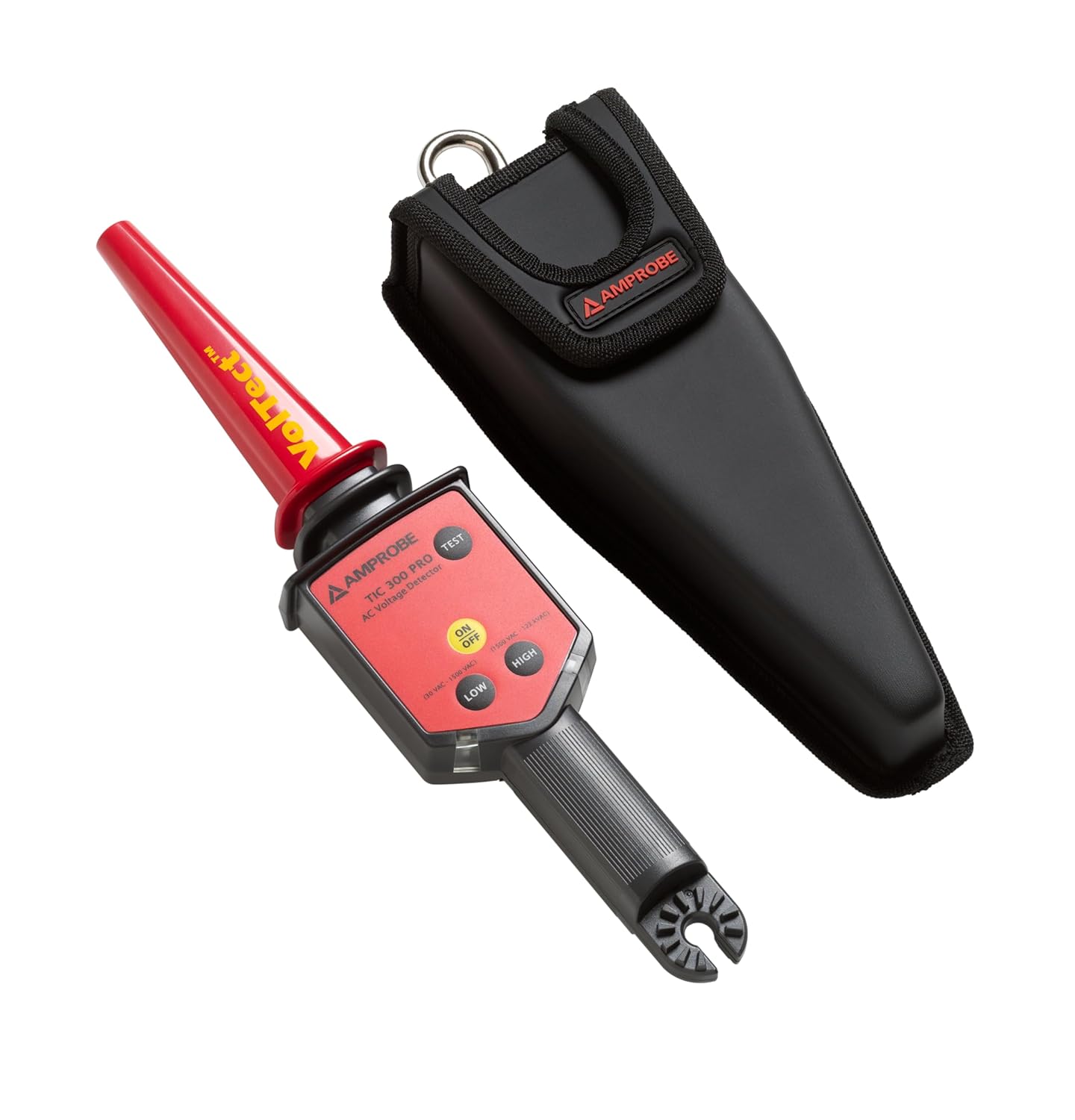
Every non contact detector has a stated detection range, and it is a floor as well as a ceiling. The pen supplied with the Klein Tools CL800 and breaker finder kit detects 50 to 1000 VAC, so a low voltage control circuit sits below what it reports. The sensor in the tip of the IDEAL 61-747 TightSight clamp meter covers 40V to 600V, while the Amprobe TIC 300 PRO splits its coverage into a 30 to 1500 VAC range and a 1500 VAC to 122 kV range.
None of those figures is a measurement. A non contact tester reports presence, not magnitude, and a bar graph that rises with field strength is an indication rather than a reading. For a number, a contact meter is required, and the handling rules are set out in how to use a multimeter safely.
Where the tool genuinely earns its place
Used as a first pass rather than a verdict, it is genuinely useful: sweeping a cable before cutting into a wall, identifying which conductor in a group is energised before probes go near it, or checking a fixture or cord without disassembly. Each narrows the problem and reduces contact with unknown wiring, provided the result is never inverted into a claim that something is dead.
Non contact options in this catalog
- Amprobe TIC 300 PRO. Detection from 30 VAC to 122 kV across two ranges, with a self test function, audible and visual indication, and MSHA certification. Suits utility and industrial technicians, and it is bulky inside a crowded residential panel.
- Extech EX330. A UL listed CAT III 600V auto ranging multimeter with a built in non contact detector and a Type K temperature probe. Suits anyone who wants both capabilities in one pocket sized body, with the caveat that its supplied leads are its weak point.
- Klein Tools CL800 clamp meter and breaker finder kit. Bundles a True RMS clamp meter with a breaker finder and a 50 to 1000 VAC non contact pen. Suits electricians who want the pen alongside measuring and tracing tools, though the clamp body is bulky in tight panels.
- Klein Tools ET450 wire tracer kit. The receiver adds a non contact voltage function and a flashlight to a tracer that follows energised and de-energised runs. Suits tracing work in walls and underground, and it needs ten AA cells.
The wider ranges sit under voltage testers and circuit testers.
FAQ
Can a non contact tester confirm a circuit is dead?
No. Silence from the tester has too many possible causes, including shielding, distance, a flat battery and a DC supply. Establishing that a circuit is de-energised is a documented procedure performed by a qualified electrician using a contact rated instrument.
Why does it beep on a wire that is switched off?
Almost always induced voltage from an adjacent energised conductor. The coupling is real but carries no meaningful current, and a low impedance contact test shows the difference.
Does it work through metal conduit?
Usually not. Grounded metal conduit and armoured or shielded cable contain most of the field, which is a common false negative on a job site.
How often should the tester be checked?
Before and after every use that matters, against a source known to be live. A self test function such as the one on the Amprobe TIC 300 PRO confirms internal operation, but only a known live source confirms detection in the conditions you are standing in.