
A lumen measures the total visible light a flashlight puts out, not how far the beam travels or how bright a spot looks at 50 metres. For household jobs, garage work and night walks, 300 to 1000 lumens is enough, and the four figure numbers printed on the box are usually a burst rating the light steps down from within minutes.
Key takeaways
- Lumens measure total output. Candela and beam distance measure how concentrated that output is.
- Roughly: 25 to 60 lumens for close inspection, 100 to 300 for walking and general use, 500 to 1500 for work and outdoors, 2000 and up for searching open ground.
- Peak lumens are typically measured in the first 30 seconds of a run. Sustained output is lower once the light warms up.
- Perceived brightness does not scale with the number. Going from 500 to 1000 lumens is a modest visible step, not double the light.
- Runtime falls steeply at the top of a light’s range, so the highest mode is a burst tool.
What a lumen actually measures
A lumen is a measure of luminous flux: the total amount of visible light emitted, weighted for how sensitive the human eye is to each wavelength. Point a light at a wall and the lumen figure describes everything hitting that wall, spread out or concentrated, it makes no difference to the number.
That is why two lights with the same lumen rating can behave completely differently. Output is only half the picture. The other half is where the light goes.
Lumens versus candela and beam distance
Candela measures luminous intensity in a single direction, which is what determines throw. Manufacturers usually translate it into a beam distance figure, defined as the distance at which the beam has fallen to 0.25 lux, roughly the light of a full moon.
Two lights in this catalogue make the point. The LUMINTOP GT Nano is a keychain light rated at 450 lumens, but its smooth reflector concentrates that output into a stated 300 metre beam. The Streamlight 66320 MacroStream is rated higher at 500 lumens, yet throws around 90 metres because the beam is spread for close and mid range use. More lumens, less reach.
So when a listing quotes only lumens, it is describing the engine and saying nothing about the gearing.
How much light each job needs
These bands are approximate, but they hold up well against the way people actually use lights.
- 25 to 60 lumens. Reading, close inspection, moving around a dark house without ruining night vision. The Streamlight 66318 MicroStream sits here at 45 lumens with a stated 41 metre reach, running about 2 hours on a single AAA cell. The Coast G20 penlight runs 54 lumens with an inspection beam designed for edge to edge evenness at close range.
- 100 to 300 lumens. Walking, car work, checking a loft or a crawl space. The Streamlight 66601 MicroStream USB covers this with 250 lumens and a 68 metre beam on high, dropping to 50 lumens and 31 metres on low.
- 500 to 1500 lumens. Job site work, outdoor tasks, lighting a whole room during an outage. The Milwaukee 2011R sits at 500 lumens with up to 75 hours on its low mode, and the Wurkkos TS12 reaches 1350 lumens with a stated 432 metre beam.
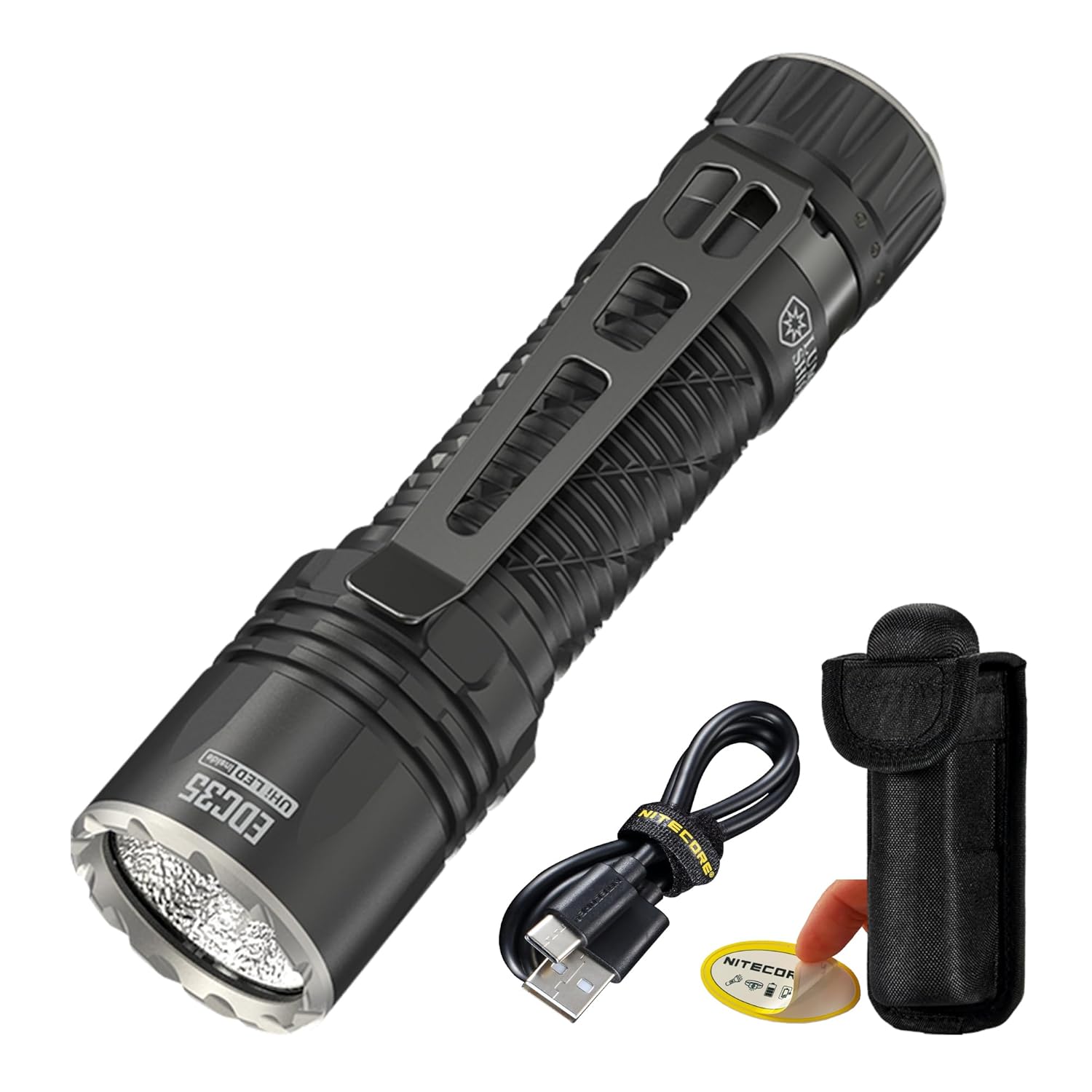
- 2000 lumens and above. Searching open ground, spotting across a field, signalling. The PowerTac M5-G3 is rated at 2030 lumens with a 330 metre beam, and the Nitecore EDC35 pushes to 5000 lumens with a stated 601 yard throw.
Why the headline number does not last
An LED running at maximum turns a large share of its input into heat. In a small aluminium body there is nowhere for that heat to go, so the driver reduces current to protect the emitter. This is thermal step down, and every compact high output light does it.
The published runtimes reflect it. The Nitecore EDC35 is quoted at around 4 hours at maximum against up to 90 hours on low. The Nitecore EDC27 reaches 3100 lumens but holds it for about an hour. Some designs work harder at shedding heat: the Wurkkos TS23 uses an electro-thermal separation layout that moves the charging port away from the emitter to help the head dissipate heat.
The practical lesson is to buy for the output you will hold, not the output you will see for 30 seconds.
Brightness you can feel versus brightness on paper
Human brightness perception is closer to logarithmic than linear. Doubling the lumens produces a noticeable but modest step, and a genuinely dramatic difference usually takes something like a fourfold increase. That is why the jump from 50 to 200 lumens feels bigger than the jump from 1000 to 2000.
Beam shape complicates it further. A wide flood at 500 lumens can make a garage feel better lit than a tight 1500 lumen thrower, because the flood fills the space instead of drilling a bright circle into one wall. Colour rendering plays a part too. The Wurkkos TS26S is rated at 95 CRI, which makes colours look closer to daylight even though its 3100 lumens is not the biggest figure in the handheld flashlights category.
Three lights across the range
- Streamlight 66318 MicroStream, 45 lumens: suits close work, glovebox duty and anyone who wants a light that runs on an AAA cell bought anywhere. At 1.04 ounces it disappears in a shirt pocket.
- Streamlight 66601 MicroStream USB, 250 lumens: suits general daily carry, with a 1.5 hour runtime on high and 3.5 hours on low. Worth knowing it charges over micro USB rather than USB-C.
- Wurkkos TS12, 1350 lumens: suits people who want real reach in a pocket light, with eight modes and up to 133 hours on the lowest setting.
- Nitecore EDC35, 5000 lumens: suits searching outdoors and long range spotting. Accept about 4 hours at maximum and roughly 6.3 ounces of weight.
FAQ
Is 1000 lumens bright enough?
For nearly all household, garage and outdoor walking use, yes. A 1000 lumen light covers a room, a driveway or a trail comfortably. Higher outputs matter mainly for distance.
Why does my flashlight dim after a minute?
That is thermal step down. The driver lowers current to keep the LED and the body within safe temperatures. It is normal behaviour on any compact light running near its maximum.
What is the difference between lumens and candela?
Lumens describe total output in every direction. Candela describes intensity in one direction, which is what gives a light its throw. Beam distance in metres is derived from candela.
Which spec should I compare first?
Compare runtime at a fixed output first, then beam distance, then peak lumens. The wider selection process is covered in how to choose a flashlight, and the power source trade-offs in flashlight battery types. If the light is for daily pocket carry, start with the EDC flashlight guide instead.