
Choosing a flashlight comes down to three numbers that pull against each other: lumens (total light output), beam distance (how far that light usefully reaches), and runtime (how long the light holds a given output). Decide which of the three matters most for the way you will actually use the light, and a catalogue of hundreds shrinks to a shortlist of three or four.
Key takeaways
- Lumens measure total output. Beam distance measures reach. A tightly focused 450 lumen light can out-throw a 700 lumen light with a wide optic.
- Quoted runtimes are usually for the lowest mode. Check the runtime for the mode you will really use.
- Most household, garage and job site work is covered by 300 to 1000 lumens.
- Sealing and impact ratings matter more than peak brightness once a light leaves the house.
- The power source decides convenience: a built in cell charged over USB-C for grab and go, swappable cells or a tool battery for long shifts.
Start with the job, not the spec sheet
Flashlight buying goes wrong when the shopping starts with the biggest number on the box. Start instead with the three or four situations where the light will come out of the pocket.
Close inspection work under a sink, inside a panel or behind a dashboard needs very little output and a lot of beam control. The Coast G20 penlight runs at 54 lumens with an inspection beam that holds a clean circular edge out to about 9 metres, which is the sort of light that shows detail instead of washing it out. Pointing 3000 lumens at a fuse box from 30 centimetres away mostly produces glare.
General carry sits in the middle: enough output to walk a dark driveway, find a dropped socket or check a breaker, in a body small enough to forget about. Searching an outbuilding, a paddock or a treeline is the only common job that genuinely calls for four figure lumens, and even then it is used in bursts.
Lumens tell you output, not reach
Lumens describe the total visible light leaving the head. How that light is distributed is set by the reflector or optic, and it is measured separately as candela or as a beam distance figure.
The catalogue shows the split clearly. The LUMINTOP GT Nano puts out 450 lumens through a smooth 20.8mm reflector and reaches a stated 300 metres. The Streamlight 66320 MacroStream puts out more light at 500 lumens, but throws it around 90 metres because the beam is spread wider for close and mid range work. Neither is wrong. They are built for different distances. There is more detail on this in the guide to lumens and how bright you actually need.
Runtime is a curve, not a single number
High output LEDs generate heat, and a small aluminium body can only shed so much of it. Most bright lights therefore step down from the headline figure after the first minutes, which is why manufacturers quote runtime by mode rather than as one number.
The Nitecore EDC35 is a fair illustration: around 4 hours at its maximum setting, and up to 90 hours on its low modes. The Wurkkos TS23 quotes up to 300 hours on its lowest moon mode and a fraction of that at 5000 lumens. When comparing two lights, compare them at the same output level, not headline against headline.
Beam colour and colour rendering
Colour temperature is quoted in kelvin. Cool white in the 6000K to 6500K range, as used in the Wurkkos TS23, looks brighter to the eye and cuts through open darkness well. Neutral white around 4000K to 5000K renders colours more naturally and is easier on the eyes for close work.
Colour rendering index is the other half of that story. A high CRI light such as the Wurkkos TS26S, rated at 95 CRI, shows wire colours, paint shades and stains closer to how they look in daylight. For anyone matching colours or inspecting finishes, that is worth more than another thousand lumens.
Power, sealing and how it carries
Three practical questions settle most of what is left. First, how does it charge? A built in lithium cell with a USB-C port is the least hassle day to day, while removable cells or a cordless tool pack let you swap in seconds when the light dies mid job. The guide to flashlight battery types covers the trade-offs.
Second, how sealed is it? IPX4 covers splashes and light rain. IP67 and IP68 cover dust and submersion, with the depth set by the manufacturer. The explanation of flashlight IP ratings sets out what each code is tested against.
Third, how does it stay put? A magnetic tail cap, a two-way pocket clip that fits a hat brim, or a right angle body that clips to a shirt pocket all free up a hand, which is often worth more on site than extra output.
Four lights that show the trade-offs
These four sit at different points on the output, reach and runtime triangle. All are covered in the handheld flashlights category.
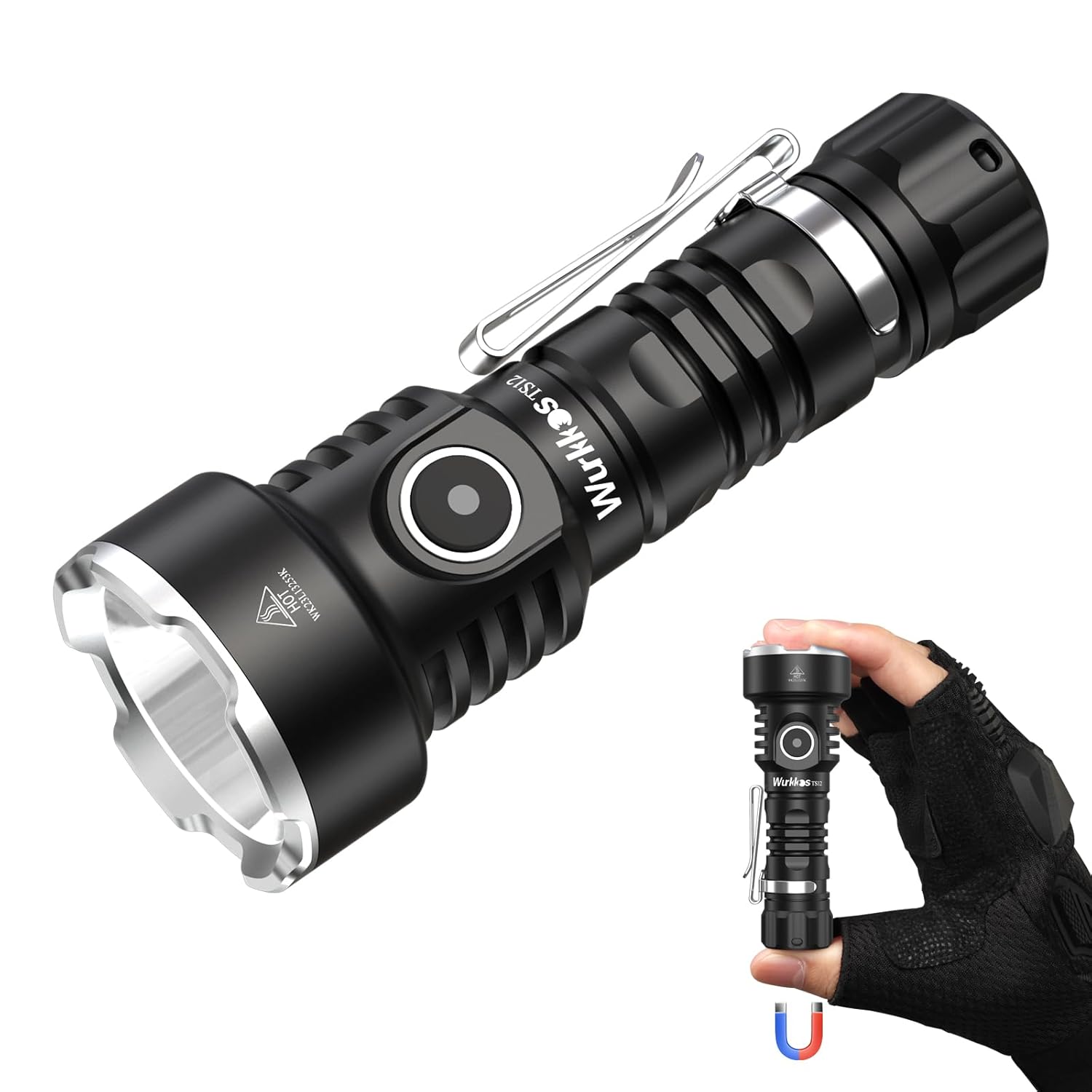
- Wurkkos TS12: 1350 lumens with a stated 432 metre beam, eight modes from moonlight upward, USB-C charging and a magnetic base. Suits someone who wants one compact light to cover the house, the car and the occasional night walk.
- Streamlight 66320 MacroStream: 500 lumens for about 2 hours or 50 lumens for about 8, with a simple tail switch and 1 metre impact rating. Suits people who want two modes and no menu. Note the IPX4 rating covers rain, not submersion.
- Nitecore EDC35: 5000 lumens, a stated 601 yard throw and an IP68 rating. Suits property checks and open ground, provided you accept roughly 4 hours at maximum and about 6.3 ounces in the pocket.
- Pelican 3410M: a right angle light running 653, 97 and 25 lumen modes on three AA cells, with 61 hours of runtime on low and a magnetic clip. Suits hands free work and emergency kits where finding replacement cells matters more than recharging.
FAQ
How many lumens do I need for general use?
For walking, driving, garage work and household repairs, 300 to 1000 lumens covers almost everything. Below 100 lumens is for close inspection. Above 2000 lumens is a searching tool used in short bursts.
Is a brighter flashlight always more useful?
No. High output shortens runtime, adds heat and produces glare at close range. A light with a well judged low mode and a beam shaped for the distance you work at is more useful day to day.
Should I buy a rechargeable light or one that takes AA cells?
Rechargeable is more convenient for daily carry. Standard cells make more sense for glovebox and emergency kits that sit unused for months. Some lights hedge both ways, such as the Nitecore MT1A Pro, which runs on its USB-C rechargeable cell or a standard AA.
What matters for a light I carry every day?
Weight, clip design, a usable low mode and a lockout to stop it switching on in a pocket. The guide to EDC flashlights goes through those points in detail.