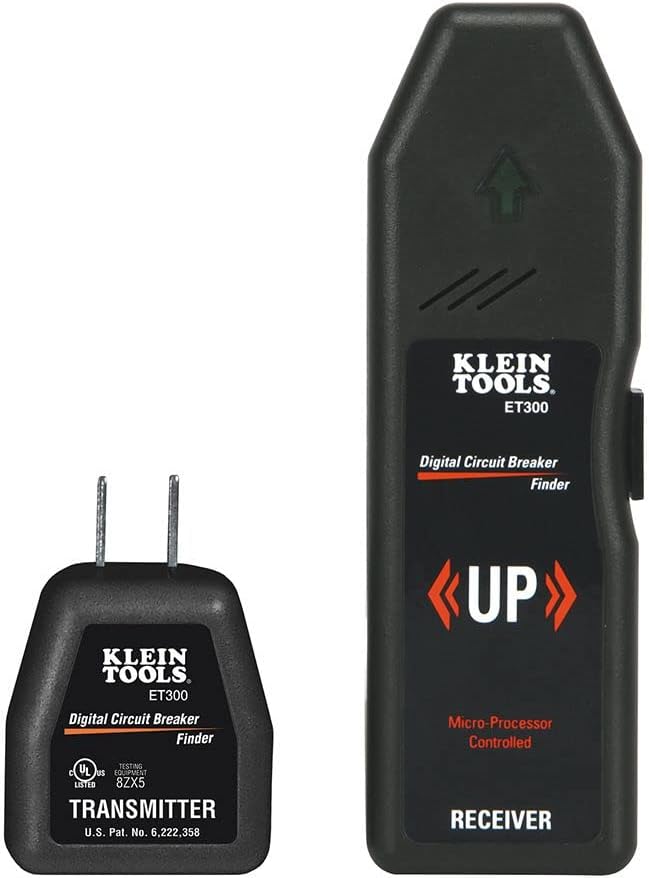

Matching an outlet to its breaker is done with a two piece circuit breaker finder: a transmitter that plugs into the outlet and injects a coded signal onto the circuit, and a receiver that is swept across the closed face of the panel until it identifies the breaker carrying that signal. The alternative, switching breakers off one at a time and checking what went dark, works but is slow and disruptive, and neither method removes the need for a qualified electrician once the panel has to be opened.
Key takeaways
- A breaker finder identifies which device feeds a circuit. It does not prove the circuit is de-energised.
- Most residential finders are specified for 120V receptacles only, so 240V circuits and hard wired equipment need a different tool or an adapter.
- Receiver sensitivity is the control that decides success. Too high and several breakers respond, too low and none do.
- Panel labels are frequently wrong after renovations, and multiwire branch circuits mean one outlet can involve two breakers.
- Scanning is done with the panel cover closed. Removing the deadfront exposes energised busbars and is work for a licensed electrician.
How a breaker finder works
The transmitter draws power from the circuit it is plugged into and modulates a distinctive pattern onto the conductors. That pattern travels back to the breaker and produces a small magnetic signature the receiver can pick up through the panel cover, reporting strength through a bar graph, an arrow or a tone. The peak identifies the candidate.
Because the transmitter runs on the circuit itself, many designs need no batteries at all. The Klein Tools ET310 transmitter is powered directly by the outlet, is rated CAT II 120V, and doubles as a GFCI outlet tester that flags common wiring faults such as open ground and reversed polarity. Only the receiver needs cells.
Why the reading is sometimes ambiguous
Breakers in a loaded panel sit close together, and the signal from one bleeds into its neighbours. That is why sensitivity adjustment exists and why it is the part of the job that takes practice. The usual approach is to start high, note which group of breakers responds, then reduce sensitivity until only one continues to peak.
Product documentation is candid about this. The Klein Tools ET310 kit notes that the receiver can require repositioning several times before the signal settles in a complex panel, and the Klein Tools CL800 kit describes the finder as needing patience because the indicators are not immediate. Metal panel covers, tightly packed breakers, sub panels and long runs all reduce signal strength.
The circuits a finder will not handle
Most residential finders are built around a standard grounded 120V receptacle. The Klein Tools ET300 is specified for 120V outlets and is not intended for 240V circuits or specialised receptacles, and its adapter and clips are sold separately. The ET310 transmitter carries the same 120V limitation.
That leaves several everyday cases uncovered. Hard wired lighting, ceiling fans, water heaters, ranges, well pumps and any circuit without a receptacle need either an adapter that connects to a light socket or bare conductors, or a full wire tracer. The Klein Tools ET450 kit is the wider tool here, tracing energised and de-energised breakers, fuses and wires with blade and ground prongs, alligator clips and lead adapters, and transmitter voltage indication spanning 12V to 480V. Connecting clips to bare conductors is electrician work, not a homeowner task.
Mislabelled panels and shared circuits
Two situations produce results that look like tool failure and are actually the building. The first is a multiwire branch circuit, where two hot conductors from opposite phases share one neutral. Switching off a single breaker can leave part of the wiring energised, which is exactly why a handle tie or a two pole device is required for those circuits and why the finder result should never be read as an isolation guarantee.
The second is a directory that no longer matches the wiring. Renovations, added sub panels and rewired rooms all leave labels stranded, and a breaker finder is genuinely valuable for rebuilding an accurate directory.
What the tool does not tell you
A breaker finder answers one question: which device feeds this point. It does not confirm the circuit is dead after that breaker is switched off, it does not detect a backfeed from a generator or inverter, and it does not identify a second supply into the same box. Establishing that a conductor is safe to work on is a separate, formal process carried out by a qualified electrician with a contact rated instrument, and a non contact pen never fills that role.
Panels are also dark. A decent handheld light makes the difference between reading a bar graph reliably and guessing at it, and the flashlight buying guide covers what to look for.
Finders in this catalog
- Klein Tools ET300. A compact 3.2 ounce finder with a flashing arrow indicator, microprocessor control, auto power off and a transmitter range quoted to 1000 feet. Suits straightforward 120V receptacle work, and the adapter and clips cost extra.
- Klein Tools ET310 kit. Adds a GFCI outlet tester with an LCD readout and trip time measurement, plus a light socket adapter and alligator clips. Suits inspection work where outlet condition matters as much as breaker identity, with the caveat that the receiver often needs repositioning.
- Klein Tools ET450 kit. A full wire tracer for energised and de-energised runs with adjustable sensitivity through drywall, cement block and underground, a non contact voltage function and a flashlight on the receiver. Suits electricians tracing unknown wiring, and it needs ten AA cells and weighs about two pounds.
- Klein Tools CL800 clamp meter and breaker finder kit. Pairs a True RMS clamp meter with a finder and a 50 to 1000 VAC non contact pen. Suits someone equipping from scratch, though the clamp body is bulky in tight panels and the finder needs patience.
The wider ranges sit under circuit testers and multi testers. For the difference between a presence check and a measurement, see voltage tester vs multimeter.
FAQ
Can one person do this without a helper?
Yes, and that is the main reason these tools exist. The transmitter stays in the outlet while the receiver goes to the panel, so nobody has to shout between rooms while breakers are cycled.
Why does the receiver flag two breakers?
Usually signal bleed between adjacent devices at too high a sensitivity setting. Reducing sensitivity in steps normally resolves it. A genuine two breaker result can also indicate a multiwire branch circuit, which is worth having an electrician confirm.
Does it work on a GFCI or AFCI protected circuit?
Generally yes, though some transmitters draw enough leakage to trip a sensitive GFCI. Manufacturer documentation for the specific model states any restrictions, and that document is the authority.
Is the breaker off the same as the circuit being safe?
No. Backfeeds, shared neutrals, mislabelled panels and second supplies all defeat that assumption. Proving a circuit dead is a procedure for a qualified electrician, and the instrument handling side of it is covered in how to use a multimeter safely.