
A fire rating on a safe is a laboratory result written as minutes at a stated temperature, and a water rating is a separate test written as hours at a stated depth. Both describe how one sample behaved under controlled test conditions, which is not the same as a promise about what will happen to the contents in a real fire or a real flood.
Understanding what each certification measures is what makes two safes comparable. This guide covers the numbers on the box, who issues the marks, and why paper and digital media are rated separately.
Key takeaways
- A fire rating combines three parts: the duration in minutes, the exterior furnace temperature, and the interior threshold that had to be maintained.
- Paper chars near 400 degrees Fahrenheit, so paper ratings target an interior below roughly 350 degrees. Digital media and film need a much lower interior figure and a humidity limit.
- Water ratings are written as hours at a submersion depth. A 24 hour rating at 8 inches and a 72 hour rating at 8 inches describe very different exposures.
- UL Classified and ETL Verified indicate an independent laboratory ran the published test. Self declared ratings do not.
- A certification is evidence about a test, not a guarantee about an event. No safe should be described as protecting its contents in a fire.
How a fire rating is produced
The safe is placed in a furnace that follows a defined temperature curve up to the rated figure, commonly 1550 or 1700 degrees Fahrenheit, and held there for the rated duration. Sensors inside record interior temperature, and often humidity. The unit passes if the interior stayed below the threshold for the class of contents throughout the window.
Some standards add an impact stage, where the heated unit is dropped onto rubble to simulate a floor collapse, then reheated and checked again. A separate drop test, such as a 15 foot drop, is sometimes certified on its own and describes shell toughness rather than heat performance.
This is why the phrasing matters. A one hour rating at 1700 degrees Fahrenheit and a 30 minute rating at 1550 degrees Fahrenheit are two different tests, and neither is a statement about how long a house fire will burn.
Why paper and digital media are rated separately
Paper begins to char in the region of 400 degrees Fahrenheit, so paper class ratings aim to keep the interior below roughly 350 degrees. That is a comparatively generous ceiling and it is what most household document safes are certified against.
Magnetic media, optical discs and flash drives fail far earlier, and they are also sensitive to the moisture that fire resistant insulation releases as it heats. Media rated safes therefore hold a much lower interior temperature and cap interior humidity as well. A safe certified for documents is not automatically certified for hard drives, and the spec sheet will say which class was tested.
Reading a water rating
Water ratings are written as a duration at a depth, and the depth is usually measured to the top of the unit or to a stated water line. Twenty four hours in up to 8 inches of water covers a burst pipe or a shallow standing flood. Seventy two hours at the same depth covers a longer exposure before anyone reaches the property. Twenty four hours under 39 inches is a submersion figure rather than a standing water figure.
The logic is the same as an ingress protection code on a tool, where a number describes a defined immersion test rather than open ended waterproofing. The comparison is set out in more detail in the explanation of flashlight IP ratings, and the same caution applies: a passing result describes a sealed unit in new condition, and gaskets age.
Many gun safes and pistol boxes carry no water rating at all, which their specifications state plainly. For a basement, garage or vehicle install that absence is a planning constraint, and the broader trade offs are covered in the gun safe buying guide.
Who issues the mark
UL Solutions and Intertek, which issues the ETL mark, are both nationally recognized testing laboratories. UL Classified means UL tested the sample against a published standard for specific properties, and ETL Verified means Intertek did the equivalent.
Read the exact wording on the packaging. Phrases such as fire resistant construction or fire rated design, with no laboratory named, are not the same claim as a classification from a named lab against a numbered standard.
Four rated safes in the review catalog
These four show how differently the same two ratings can be specified. More units sit in the cabinet safes and safe accessories categories.
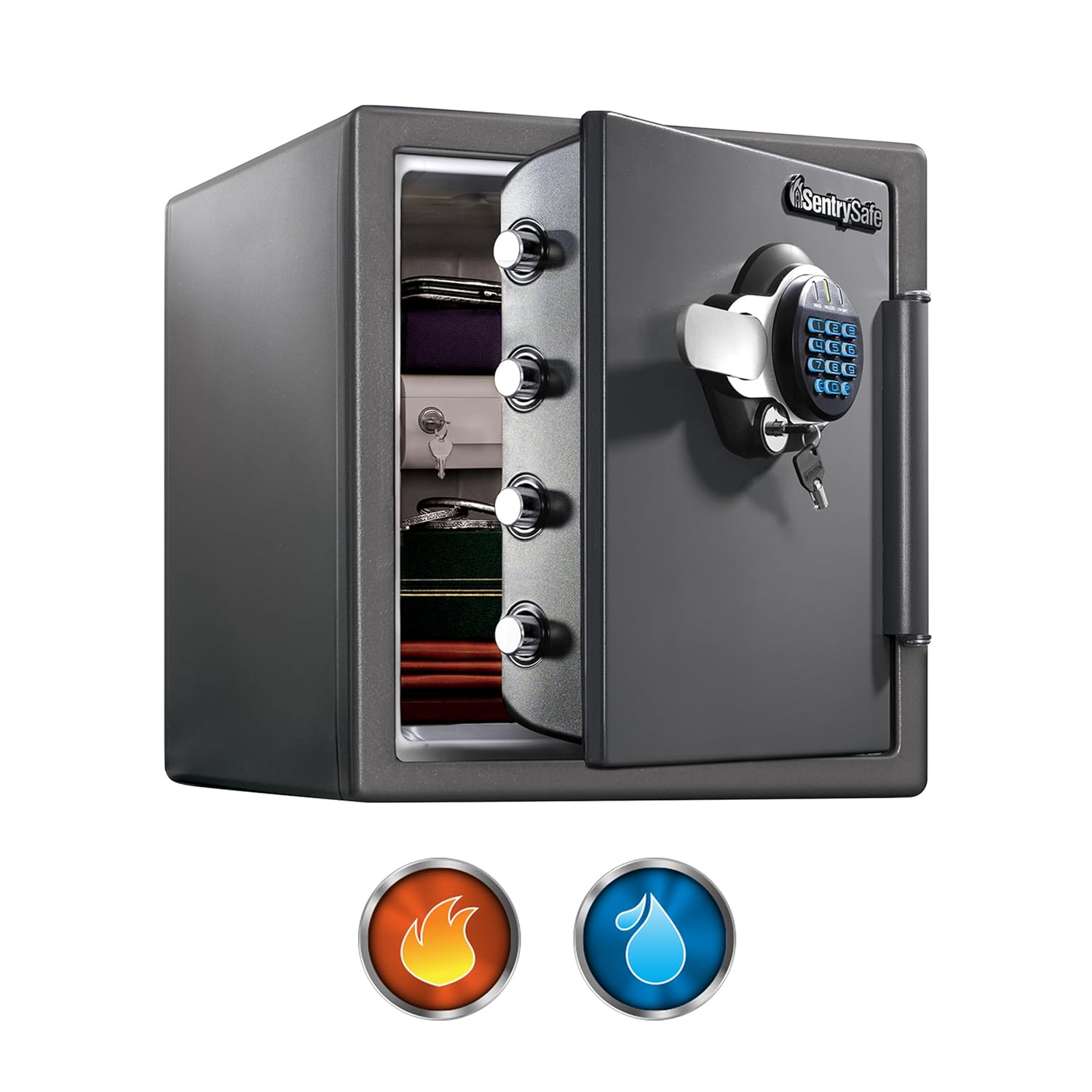
- SentrySafe SFW123GDC. UL Classified for one hour at 1700 degrees Fahrenheit, ETL Verified waterproof for 24 hours in up to 8 inches of water, and ETL Verified for a 15 foot drop. Four 1 inch live locking bolts, around 86 pounds. It suits a household wanting both ratings in one bolt down unit.
- SentrySafe HD4100. Certified for 1550 degrees Fahrenheit for half an hour, with an ETL Verified waterproof rating of 72 hours at 8 inches. About 39 pounds, 0.65 cubic feet, flat key lock. It suits someone prioritizing water exposure over furnace duration.
- Honeywell 1114 chest. One hour at 1700 degrees Fahrenheit and waterproof up to 24 hours under 39 inches of water, in a 0.39 cubic foot chest with a carry handle. It suits documents stored flat, with no interior compartments and about 42 pounds to lift.
- Kodiak KBX5629. A long gun cabinet rated for 30 minutes at 1400 degrees Fahrenheit, with fireboard in the ceiling, walls, floor and door. It suits a collection that needs capacity first, at a shorter fire window than the document safes above.
Water damage frequently follows a fire, and moisture trapped in a wall cavity is not visible from the outside. A survey with an infrared camera is one way inspectors map that, as described in the guide to thermal imagers and who needs one.
Frequently asked questions
Does a one hour rating mean documents survive a one hour fire?
No. It means a sample kept its interior below the threshold for the class of contents during a one hour furnace run at the stated temperature. A structure fire has its own temperature profile, duration, collapse behavior and suppression water, none of which the test reproduces.
Can a fire safe be reused after exposure to heat?
Manufacturers generally treat fire resistant insulation as single use, because the material works partly by releasing bound moisture as it heats. Contact the manufacturer after any heat event rather than assuming the rating still applies.
Is a waterproof rating the same as submersible?
Not necessarily. A rating quoted as hours in up to 8 inches of water describes standing water around the base, while a figure such as 24 hours under 39 inches describes full submersion. Check which one the manufacturer states.
Should a safe be bolted down even if it is rated?
Fire and water ratings say nothing about theft. Bolt down hardware is supplied with most household safes for that reason, and the manufacturer instructions cover fastener type and floor requirements.