
A reciprocating saw is a demolition and rough cutting tool. It exists to cut things apart quickly in places no other saw can reach, and it is not meant to produce a straight or finished edge.
That matters because most frustration with these saws comes from asking them to do a jigsaw’s job. Judge one on how fast it removes a nail embedded stud or a cast iron waste pipe, not on the cut face it leaves behind.
Key takeaways
- The core jobs are demolition, remodel cutting, plumbing, pruning and metal cut off in awkward positions.
- Blade choice does most of the work: teeth per inch, blade length and blade material matter more than motor size.
- Roughly 6 TPI for fast wood, 8 to 10 TPI for nail embedded wood, 14 to 18 TPI for general metal, 18 to 24 TPI for thin wall tube and sheet.
- Orbital action speeds up wood cutting and should be switched off for metal.
- Pressing the shoe firmly against the work is the single biggest control over vibration, blade life and kickback.
The jobs it does well
Demolition is the obvious one. It cuts studs, joists, sheathing, lath and plaster in place, and with the right blade it goes straight through nails and screws, which no wood blade on any other saw will tolerate.
Plumbing and mechanical work is the second big use. Copper, PVC, ABS, cast iron soil pipe, threaded rod, EMT conduit and strut are all reciprocating saw material, largely because the blade reaches into a joist bay or behind a fixture where nothing else fits.
Then there is the awkward category: cutting a stud flush to a floor plate, pruning branches, trimming roots, cutting a rusted bolt off a bracket. The saw is chosen for access, not finesse. Compact models such as the Makita XRJ08Z, listed at 5.5 pounds for one handed use, exist for overhead and in cavity work.
The jobs it does badly
Straight lines in sheet goods are not its work. The blade is unsupported past the shoe and flexes, so a cut in plywood wanders and the underside splinters. Use a circular saw against a straightedge, or the approach described in circular saw versus track saw.
Curves and cutouts in finished material belong to a jigsaw, which has a shorter stroke, a supported base and blades ground for a clean edge; the jigsaw blade guide covers that difference. Repeatable crosscuts belong to a miter saw, and controlled metal cutting in a shop belongs to a band saw.
Blades: teeth per inch, length and material
Teeth per inch, or TPI, decides whether a cut takes ten seconds or two minutes. The rule is the same as for any saw: at least three teeth in contact with the material at once. Too few and the blade snags and snaps; too many in thick softwood and the gullets pack and the blade stalls.
- 3 to 6 TPI. Fast, rough cuts in clean wood, green branches and pressure treated timber.
- 8 to 10 TPI. Nail embedded wood and general demolition. The usual default blade to keep in the case.
- 14 to 18 TPI. General metal: angle iron, rebar, bolts, cast iron.
- 18 to 24 TPI. Thin wall tube, conduit, sheet metal and unistrut, where a coarse blade would strip its teeth on the wall.
Materials divide simply. High carbon steel is flexible and cheap and belongs in clean wood. Bi metal welds a high speed steel edge to a spring steel body and is the general purpose choice for nail embedded wood and metal. Carbide tipped blades last far longer in cast iron, fiber cement and hardened fasteners, and carbide grit blades with no teeth at all cut tile, masonry and fiberglass.
Stroke length, speed and orbital action
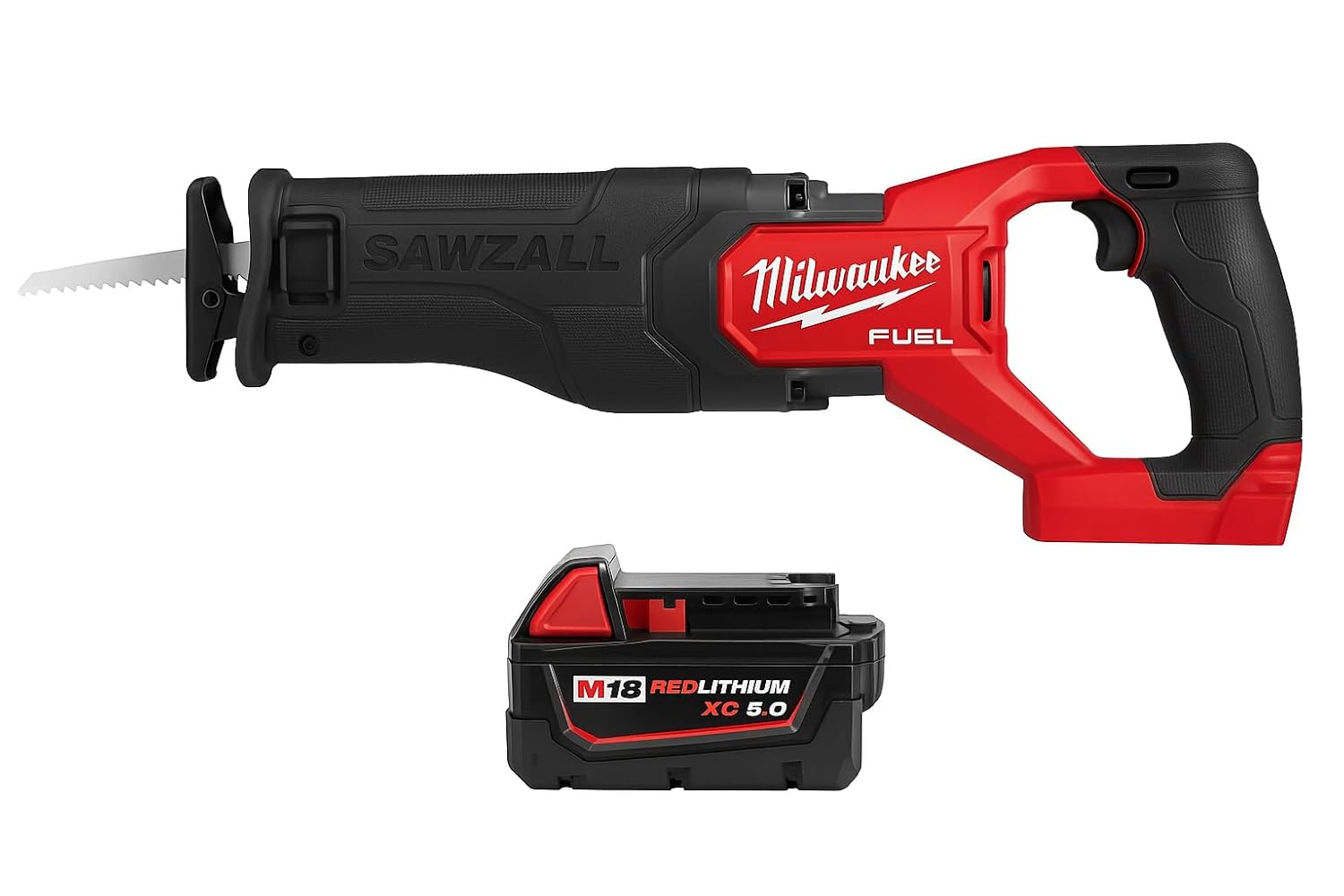
Stroke length is how far the blade travels each cycle. A longer stroke moves more teeth through the work, removing material faster and spreading wear across more of the blade, which is why the Milwaukee M18 FUEL Sawzall uses a 1-1/4 inch stroke.
Strokes per minute is the other half. Corded demolition saws such as the Milwaukee 6519-31 run up to 3,000 strokes per minute from a 12 amp motor. High speed suits wood, while metal wants a slower speed because heat is what kills a blade in steel. A variable speed trigger is how that is controlled.
Orbital action swings the blade in a slight ellipse so it bites on the pull stroke and lifts on the return. In wood it increases cutting speed considerably. In metal it wrecks blades, because the teeth are levered sideways into material that will not yield. Saws with a selectable setting, such as the Ridgid R3002 with its orbital and straight line modes, let you switch between the two. Vibration is the practical limit on how long anyone can hold one of these saws, which is why counterweighted mechanisms matter on a tool used for hours rather than minutes.
Safe practice with a reciprocating saw
The dominant hazard is the saw jumping when the shoe is not held against the work. Press the shoe flat and firm before the blade touches the material and keep it there through the cut. If the blade binds, the whole tool will buck, and with a long blade in a wall cavity that means an uncontrolled tool in an unsighted space.
- Assume any wall or floor contains live cables, gas and water. Isolate services and check with a detector before plunging into a cavity.
- Let the saw reach speed before contact and stop before withdrawing the blade.
- Blades get extremely hot in metal. Let them cool before changing them.
- Support the offcut. A falling section can trap the blade or land on you.
- Wear eye protection, and remove the battery or unplug before changing blades or adjusting the shoe.
Blade clamp mechanisms, shoe adjustment and orbital selectors differ between machines. Follow the manual for the specific saw you own.
Reciprocating saws in this catalog
- Milwaukee 2821-21 M18 FUEL Sawzall. A 1-1/4 inch stroke with an adjustable shoe, LED and hang hook. Suits demolition and remodel work where cords are a nuisance.
- Milwaukee 6519-31 corded reciprocating saw. 12 amps to 3,000 strokes per minute, with tool free blade changes and a gear protecting clutch. Suits sustained heavy cutting where runtime cannot be the limit.
- Ridgid R3002 compact orbital saw. 9 amps with selectable orbital and straight line modes and a tool free pivoting shoe. Suits switching between wood and metal on the same job.
- Makita XRJ08Z 18V LXT. 5.5 pounds with a low vibration design and tool less blade changes. Suits overhead work, tight cavities and one handed positions.
The rest are in the reciprocating saws category.
Frequently asked questions
Why do the blades keep bending?
Usually the shoe is not held against the work, or the blade is longer than the job needs. Bi metal blades tolerate flex far better than high carbon steel.
Can it cut tree branches?
Yes, with a coarse pruning blade in the 3 to 6 TPI range. Green wood packs fine teeth quickly. Work from a stable position, never from a ladder while cutting overhead.