
A thermal imager shows the surface temperature of whatever it is pointed at, rendered as a picture, which makes it a tool for finding temperature differences rather than for seeing through anything. It does not see through walls or inside a panel cover; it reads the outside face of the nearest object and nothing behind it.
That limitation defines the tool. Everything useful an imager does, from spotting a loose lug on a breaker to mapping where insulation stopped, works because heat conducts to a surface the camera can see.
Key takeaways
- Thermal resolution is the sensor pixel count. 80 by 60 is 4,800 pixels, 160 by 120 is 19,200, and 256 by 192 is 49,152. Display resolution is a different and larger number.
- NETD, quoted in millikelvin, is the smallest temperature difference the sensor can distinguish from its own noise. Lower is better, and under 40 mK is a strong figure at consumer level.
- Emissivity changes the reading. Bare shiny metal reads far cooler than it is, and a patch of matte tape is the standard correction.
- An imager finds where a problem is. A meter still measures what the problem is.
Thermal resolution is the first number
The infrared sensor in a handheld imager is a microbolometer array, and its pixel count is the resolution that matters. An 80 by 60 array has 4,800 thermal pixels, 160 by 120 has 19,200, 256 by 192 has 49,152, and 320 by 240 gives 76,800. Every pixel is one temperature measurement, so a low count array averages a broader patch of the scene into each one.
The practical consequence is target size at distance. A small hot spot such as a single terminal on a busy panel occupies a fraction of a pixel on a low resolution array, and its temperature is averaged with the cooler metal around it, so it reads as a milder anomaly than it is. Getting closer helps, and more pixels helps more.
Watch the second number on a spec sheet, since manufacturers list a visual camera resolution too, far higher than the thermal array. Overlay technologies such as MSX emboss edges and text onto the thermal image, making the picture easier to read without adding a single thermal pixel.
What NETD actually measures
NETD stands for noise equivalent temperature difference, the point at which a real temperature difference in the scene becomes as large as the electrical noise of the sensor itself. A rating under 40 mK means the sensor resolves differences below 0.04 degrees Celsius before noise swamps them.
Resolution decides how small a feature can be isolated, and NETD decides how faint a difference can be seen at all. Building envelope work leans hard on NETD, because a draft or a missing batt of insulation may show as a fraction of a degree across a wall. Electrical work leans on resolution, because the anomalies are hot and obvious but physically tiny.
Frame rate is the third number. Many handhelds run at 9 Hz, a threshold tied to export control rules, which is adequate for reading a static target. Panning across a wall at 9 Hz smears the image, so units at 20 or 25 Hz are easier to sweep with.
Emissivity, reflection and false readings
An imager measures emitted infrared radiation and converts it to temperature using an assumed emissivity, typically preset around 0.95. Painted surfaces, wood, brick and plastic sit close to that and read accurately. Bare polished metal can fall below 0.1, so a hot copper busbar reads dramatically cooler than it actually is.
The correction is straightforward: stick a patch of matte electrical tape on the shiny surface, let it reach the surface temperature, and read the tape. Low emissivity surfaces also act as mirrors in the infrared band, so an apparent hot spot on a metal panel is sometimes a reflection.
Two habits catch most errors. Move the camera and watch whether the hot spot moves with you, since a reflection tracks the observer while a real one stays put. And compare against a similar component under similar load, because a phase running 20 degrees hotter than its neighbors is the finding, not the raw temperature.
Who actually needs one
Electricians scan panels, connections and motor terminations for the resistance heating that flags a loose or corroded joint. HVAC technicians check coils, registers, ducts and compressor temperatures. Inspectors and energy auditors map insulation gaps, air leakage and moisture patterns. A homeowner doing occasional work is usually served by a spot infrared thermometer instead. The tell is whether the job means finding an unknown location, which is imaging work, or measuring a known location, which is thermometer work.
An imager also stops where diagnosis begins. Locating a warm breaker narrows the search, and the measurement that follows belongs to a meter, as covered in the clamp meter guide, the notes on how to use a multimeter, and the walkthrough for finding a circuit breaker.
Four imagers from the review catalog
Four units at different points on resolution, frame rate and form factor, from the thermal imagers category, with meters in multi testers.
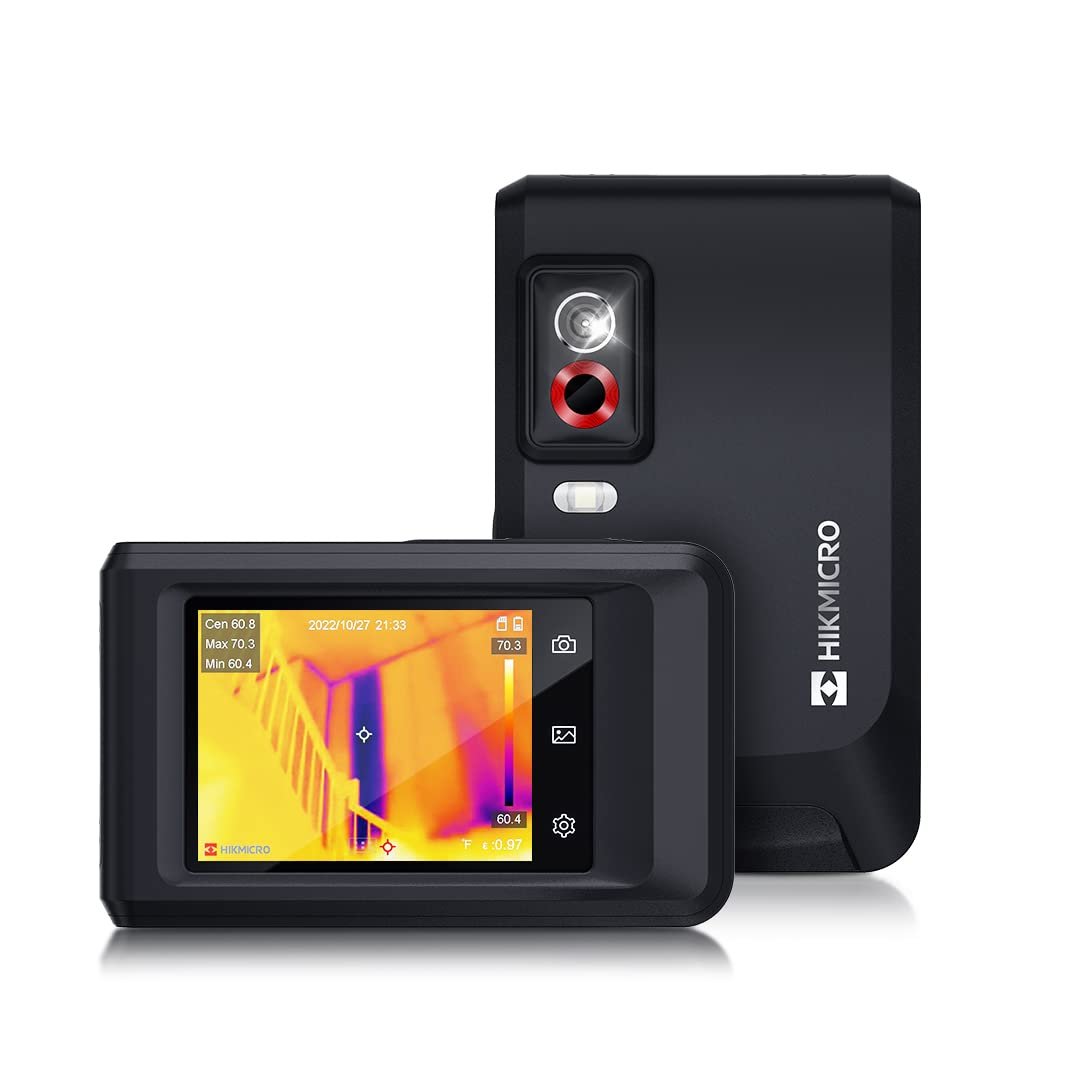
- HIKMICRO Pocket2. A 256 by 192 array giving 49,152 thermal pixels, NETD under 40 mK, 25 Hz, an 8 MP visual camera, a 3.5 inch touchscreen and a range of -4 to 752 degrees Fahrenheit, IP54 rated. It suits a technician wanting the fastest sweep rate here in a pocket body, at about four hours per charge.
- TOPDON TC004. The same 256 by 192 array at 20 Hz with sensitivity under 40 mK, a range of -4 to 662 degrees Fahrenheit and a 5000 mAh battery quoted at 12 hours. It suits long inspection days, and at 2.11 pounds it is the heaviest of the four to hold.
- FLIR TG165-X. A lower resolution handheld leaning on MSX overlay and a bullseye laser for targeting, covering -13 to 572 degrees Fahrenheit at 9 Hz, IP54 and just under 14 ounces. It suits spot checks where knowing which component is being measured matters more than pixel count.
- FLIR ONE Pro LT. An 80 by 60 thermal array with a 1440 by 1080 visual camera and MSX processing, running at 9 Hz through the Lightning port of an iPhone. It suits occasional household diagnosis, and it will not work with USB-C iPhones from the 15 generation onward.
For single point work, the Milwaukee 2267-20 Temp-Gun shows the alternative, with a 10 to 1 distance to spot ratio, meaning the measured circle is one tenth of the distance to the target.
Frequently asked questions
Can a thermal imager see through walls?
No. It reads the surface facing the lens. Studs, pipes and wiring become visible only when they change the temperature of the wall surface itself, which requires a temperature difference across the assembly.
Is a higher resolution always worth paying for?
It depends on target size and working distance. Small targets viewed from a distance, such as individual terminals in a live panel, benefit most. Large surfaces such as walls and roofs are more sensitive to NETD than to pixel count.
Why does 9 Hz appear so often?
Export control rules have long treated higher frame rates differently, so many consumer and light commercial imagers are built at 9 Hz. That is fine for static measurement and choppy when panning.