
Replace an air purifier filter when the manufacturer interval expires, and treat that interval as the ceiling rather than a fixed date, because it is quoted in runtime hours and most people run their unit far less than continuously. Typical figures across the category run from about four months to twelve months, or roughly 3,000 runtime hours for a portable cartridge and up to 12 months for deep pleated whole house media.
The difficulty is that no two makers express the interval the same way. This guide covers how to convert hours to months, what genuinely shortens filter life, and which parts are washable and which are not.
Key takeaways
- A 3,000 hour rating equals roughly four to five months of continuous running, or considerably longer at eight hours a day.
- Pre filters are often washable. HEPA media never is, and washing it damages the fiber structure and the seal.
- Carbon layers saturate on their own schedule and usually expire before the particulate media is loaded.
- Write the install date on the cartridge frame. It is the single most reliable record, and it costs nothing.
Hours, months and what the rating assumes
When a maker rates a cartridge at 3,000 hours and also states four to five months, those two figures are the same claim. Three thousand hours divided by 24 is about 125 days, which lands squarely in that four to five month window. The month figure therefore assumes the unit runs around the clock.
Run the same unit eight hours a day and 3,000 hours becomes roughly twelve months of calendar time. That gap is why two owners of identical purifiers can honestly report very different filter lives. Before deciding a filter has underperformed, check whether the comparison is being made in hours or in months.
Whole house media in a ducted cabinet is rated differently again, commonly up to 12 months, because a four inch pleat holds far more dust and the blower only runs during heating and cooling calls. Depth is what buys that interval, as covered in the explanation of HEPA filters, H13 and MERV.
What actually shortens filter life
Four variables dominate. Runtime hours are the largest. Particulate load in the room is second, and construction dust, wildfire smoke season or a shedding pet will load media measurably faster than a quiet bedroom. Fan speed is third, since a unit held on high moves more dust through the media per hour. Room size is fourth, because an undersized purifier runs harder for longer to achieve the same air changes.
Odor exposure is the variable that catches people out, and it acts on the carbon rather than the particulate layer. Cooking, smoke and solvent vapors saturate activated carbon well ahead of the HEPA media reaching capacity, so a stacked cartridge in a heavy odor environment often expires while the pleats still look clean.
Indicator lights and what they measure
There are two designs. A timer counts elapsed runtime and lights up at a preset number of hours regardless of conditions, so it never accounts for a dusty month. A sensor assisted system weighs runtime against measured particulate levels, producing an estimate that moves with actual conditions.
Both types are usually tied to genuine cartridges, either through a chip, a magnet or a reset procedure documented in the manual. Third party filters can fit and seal correctly while leaving the indicator unable to track them, so a manual log of the install date is worth keeping either way.
An indicator that has not lit is not proof a filter is fine. Reduced airflow at the outlet, more fan noise at the same speed setting, visible grey loading across the pleat face, or odors reappearing at settings that previously handled them are all worth acting on ahead of the light.
Pre filters, washing and handling
Washable pre filters are the maintenance item that extends everything behind them. Rinsing a mesh pre filter monthly keeps hair and coarse dust off the fine media, and it must be fully dry before it goes back in. HEPA media is different: it cannot be washed or reused after cleaning, because the fiber structure and the gasket seal are what deliver the rated efficiency.
Handle new cartridges by the frame rather than the pleat face, and remove any protective plastic wrapping before fitting, since leaving it on blocks airflow entirely. Replacing filters in a ceiling mounted or high wall unit means working at height, so the setup points in the ladder safety guide apply. In a dim utility closet a compact inspection light makes the date code and airflow arrow legible, and beam types are compared in the notes on how to choose a flashlight.
Stated intervals on catalog cartridges
Four cartridges from the air purifier filters category, each stating its interval in a different way.
- Medify Air MA-112 replacement filter. Rated up to 3,000 hours or about four to five months, in a pre filter, H13 HEPA and carbon stack. It suits an owner who wants the hour figure stated explicitly, and at roughly six pounds it is bulky to swap.
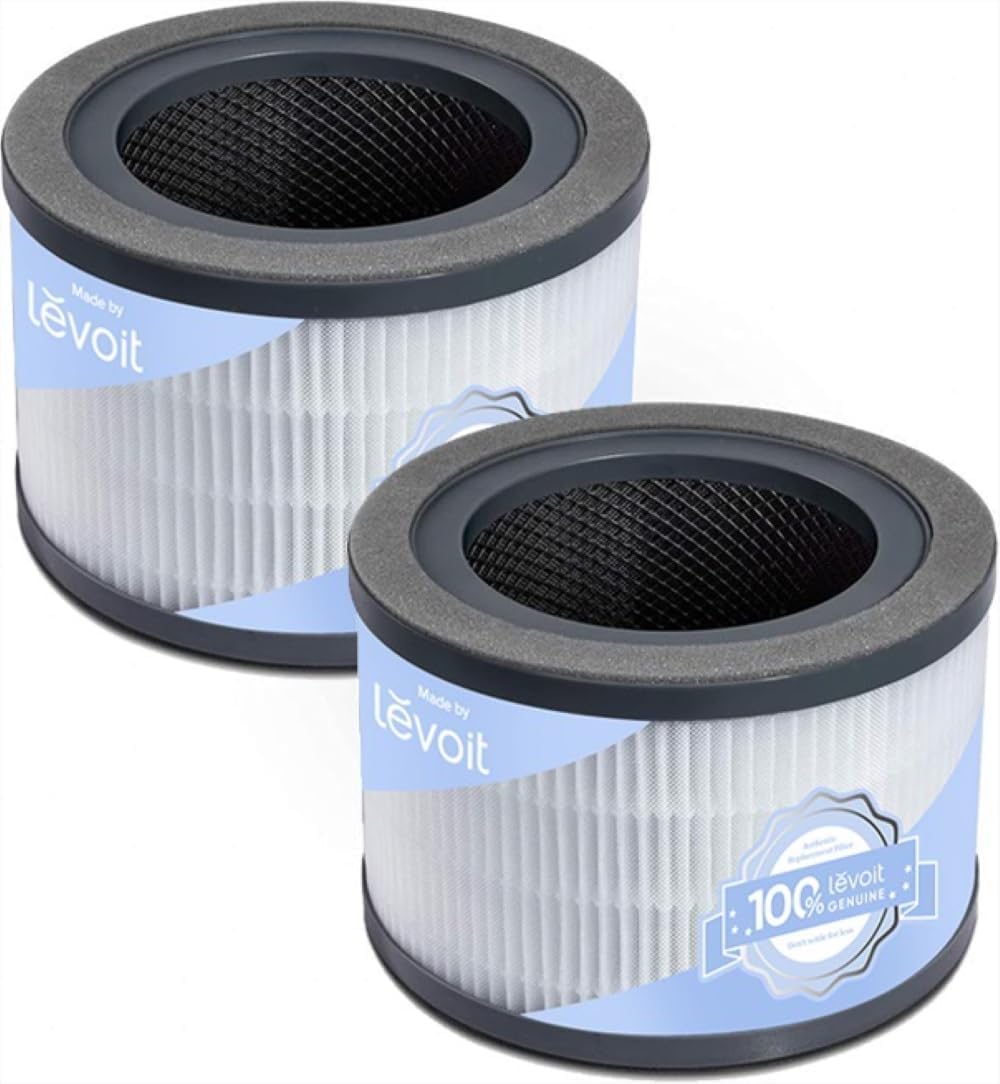
- LEVOIT Vista 200 replacement filter. Officially every five to seven months, with a washable pre filter and a filter life indicator that tracks genuine cartridges only. It suits someone who wants the indicator to count, though owner reports in homes with pets put the interval closer to four months.
- Blueair Blue Pure 211i Max filter. Rated up to nine months, with a usage and pollution based algorithm calculating remaining life rather than a fixed timer. It suits an owner wanting the longest stated interval here, and it does not fit the 211+ models.
- HATHASPACE HSP001 replacement filter. A four stage stack with a manufacturer recommendation of every four months, the shortest interval here. It suits an HSP001 owner who accepts a fixed short cycle, and it fits that model only.
Wide windows appear too. The Shark HE601 filter is quoted at six to twelve months, a range broad enough that the runtime log matters more than the label.
Frequently asked questions
Can a HEPA filter be vacuumed instead of replaced?
No. HEPA media relies on an undisturbed fiber structure and an intact gasket seal, and vacuuming or washing degrades both. Only pre filters described as washable by the manufacturer should be cleaned and reused.
How do runtime hours convert to months?
Divide the rated hours by the hours the unit runs per day, then divide by about 30. A 3,000 hour rating is roughly four months at 24 hours a day, about eight months at 12 hours a day, and about twelve months at 8 hours a day.
Do third party cartridges reset the indicator?
Sometimes. Many indicators are reset manually through a button sequence in the manual and will accept any cartridge, while usage tracking algorithms tied to genuine filters may not track a third party part correctly. Keep a written install date regardless.
Should the whole stack be replaced at once?
On sealed three in one and four in one cartridges, yes, because the layers are bonded into one unit. Units with separate pre filter, HEPA and carbon elements can be serviced individually, and the carbon element commonly needs attention first.