
A good everyday carry flashlight is one you actually carry, which puts weight, shape and clip design ahead of peak output on the list of things that matter. In practice that means something under about 5 ounces, with a low mode you will use far more than turbo, a lockout to stop it switching on in a pocket, and a charging method you already have cables for.
Key takeaways
- Carryability decides everything. If the light is heavy or awkwardly shaped, it stays in a drawer.
- A genuine low or moonlight mode gets used daily. Turbo gets used occasionally.
- A lockout function prevents pocket activation, which otherwise drains the cell and heats the body.
- 200 to 1000 lumens covers virtually every carry situation.
- USB-C is the practical charging standard. Check whether the cable is actually in the box.
Weight and shape decide whether you carry it
Pocket space is the real constraint. A cylindrical light rolls, prints through fabric and competes with keys and a phone. Flat and keychain shapes solve that in different ways.
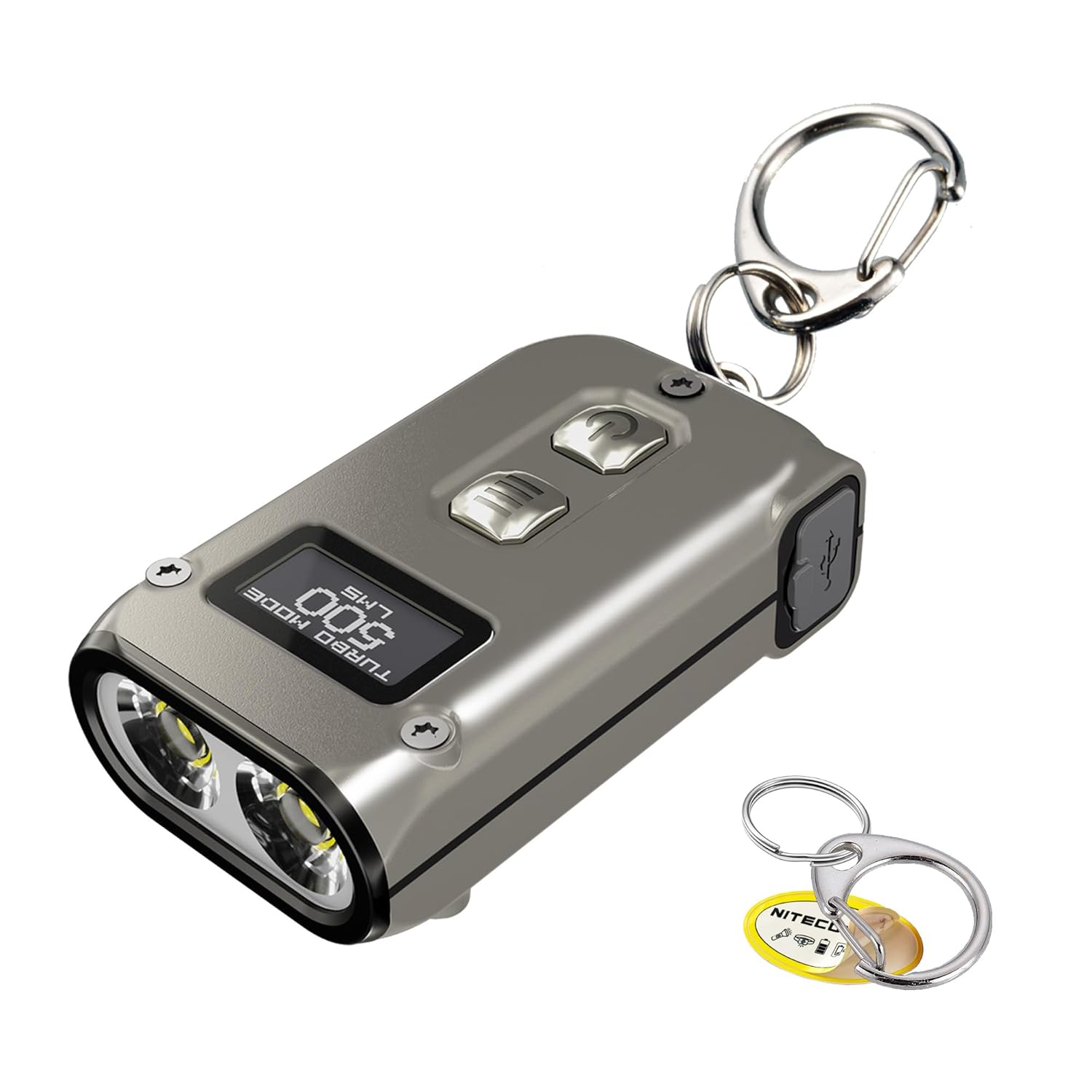
At the small end, the Nitecore TINI 2 measures roughly 1.83 by 0.98 by 0.49 inches and weighs about 0.66 ounces, which is less than most car keys. The RovyVon A3 is smaller again at about 2.38 inches and 0.35 ounces.
Flat bodies are the other approach. The Klarus E5 is 4.2 by 1 by 0.3 inches and 1.26 ounces, so it lies against a pocket lining rather than filling the pocket. The Nitecore EDC27 takes the same shape further at 0.56 inches thick and 4.3 ounces, trading some weight for far more output.
The low mode matters more than turbo
Most real uses of a carry light are close range: finding a keyhole, reading a meter, checking under a car seat, walking a corridor without waking the house. All of those are better served by 5 to 50 lumens than by 2000.
A low mode also protects night vision, which takes several minutes to recover after a bright flash. Look for a moonlight setting and a runtime figure to match. The Wurkkos TS12 quotes up to 133 hours on its lowest mode, and the OLIGHT Arkfeld Pro up to 55 hours on its lowest setting. Those numbers matter more day to day than the top of the range.
Interface, lockout and one handed use
A carry light gets operated with one hand, often the wrong hand, often in the dark. Two things make that workable: a switch you can find by feel, and a mode order that starts where you want it.
Lockout is the feature people skip and then regret. Without it, a switch pressed against a car seat can run the light at full output inside a pocket. The RovyVon A3 uses a five click switch specifically to prevent accidental activation. The Nitecore TINI 2 offers a lockout mode plus an OLED readout showing brightness, battery voltage and remaining runtime. The JETBeam E26 combines a memory function that returns to the last mode with a lockout to stop the selector being nudged in a bag.
Charging and power on a carry light
Sealed cells with USB-C charging dominate this category because they keep the body small. The trade-off is that a flat light is out of action until it charges, so a light you rely on is worth topping up on a schedule rather than when it dies.
Two details are worth checking before ordering. First, whether a cable is included: neither the TINI 2 nor the RovyVon A3 ships with one, which is easy to miss. Second, whether the port is covered. The Nitecore EDC27 leaves its USB-C port uncovered, which is convenient but leaves the contacts exposed to dust and damp over time. If you want a fallback that does not depend on charging at all, the Nitecore MT1A Pro runs on a standard AA as well as its rechargeable cell. The wider comparison is in flashlight battery types.
Durability and sealing for pocket life
Sealing ratings vary more than people expect at this size. The Klarus E5 is rated IPX4, which covers splashes and not much more. The RovyVon A3 is IPX6, rated against powerful water jets. The Fenix E06R is IP66 and rated to survive a drop of about a metre. The Nitecore MT1A Pro carries an IP68 rating and a 2 metre impact rating. Full detail on what each code is tested against is in IP ratings for flashlights.
Extras that earn their place
- A magnetic tail or base. Sticking the light to a bonnet, a consumer unit door or a steel bench frees both hands. The Klarus E5 and the Wurkkos TS12 both offer this.
- A two-way pocket clip. Clipping bezel down in a pocket and bezel up on a cap brim covers both carry and hands free work.
- A secondary emitter. The Fenix E06R adds a UV output to its 700 lumen white light, useful for spotting stains or checking documents. What that is genuinely good for is covered in what a UV flashlight is actually used for.
- A battery readout. A voltage or percentage display removes the guesswork about when to charge.
Four EDC lights worth a look
Each of these makes a different compromise. All sit in the handheld flashlights category.
- Nitecore TINI 2: 500 lumens, a stated 97 yard beam and an OLED display, on a keyring at 0.66 ounces. Suits people who want the light attached to their keys and will accept sourcing their own USB-C cable.
- RovyVon A3: 650 lumens from a 0.35 ounce body with four brightness levels including moonlight. Suits minimalists. The IPX6 rating covers jets and rain rather than submersion.
- Klarus E5: a flat 1.26 ounce light with a main LED and a separate top light, 600 lumens maximum, around 6.5 hours at medium. Suits pocket carry in dress trousers. IPX4 means keep it out of standing water.
- Nitecore EDC27: 3100 lumens and a stated 333 yard throw in a flat stainless body with a digital display. Suits someone who wants serious output in a carry shape and can live with about an hour at maximum.
FAQ
How many lumens does an EDC flashlight need?
Between 200 and 1000 lumens suits nearly every carry use. What matters more is having a low mode in the single or low double digits for close work. See lumens explained for the full breakdown.
Keychain light or pocket light?
A keychain light is always with you but has short runtime and a small reflector. A pocket light gives more output, reach and runtime, but only if you remember to pocket it. Plenty of people carry both.
Why does my light turn on in my pocket?
Because it has no lockout engaged, or the switch sits proud of the body. Use the lockout function if the light has one, or carry it bezel down so pressure lands on the head instead of the switch.
Do I need a tactical light for everyday carry?
For most people, no. Strike bezels and momentary tail switches add length and weight that work against daily carry. If you want the full selection process, start with how to choose a flashlight.