
Nearly every jigsaw sold today takes a T shank blade, which drops into a keyless clamp and locks without a tool. Once the shank is settled, the blade you pick comes down to three things: teeth per inch, tooth grind, and the material the blade is made from.
Get those three right and a jigsaw cuts curves in plywood cleanly and follows a line without wandering. Get them wrong and the same saw burns, chips the veneer, or bows the cut out of square on the underside.
Key takeaways
- T shank is the modern standard. U shank is the older universal type and is now mostly found on legacy saws.
- Wood blades run roughly 6 to 12 TPI. Metal blades run 14 to 24 TPI, following the rule of three teeth in the material.
- Standard blades cut on the up stroke and tear the top face. Reverse tooth blades cut downward for laminate and veneered panels.
- Turn orbital action off for metal and tight curves, and up for fast straight cuts in thick wood.
- A cut that leans out of square underneath is usually blade deflection, not a bent shoe.
T shank versus U shank
The shank is the end that goes into the saw. A T shank has a tang on the back that engages a spring loaded clamp, so the blade seats positively and releases with a lever. A U shank has a rounded slot and was traditionally held by a set screw, though some later saws take both.
Practically, T shank is what to buy. It holds more securely, changes faster and has the wider selection on the shelf. Saws with keyless clamps, such as the DEWALT DCS335B with its all metal mechanism, are built around it. On an older saw with a set screw clamp, check the manual before assuming a T shank will seat.
Reading the blade code
Most brands follow a numbering convention that started with Bosch, so codes are broadly readable across makes. The leading T marks the shank, the number indicates the length group, and the letter suffixes indicate tooth pitch and blade material.
- A is the finest pitch in its family, for thin material and clean edges.
- B is a medium pitch for clean cuts in wood. T101B is the common general purpose wood blade.
- C and D are coarser and faster. T144D is a typical fast cutting blade for thick softwood.
- F indicates bi metal construction and HM indicates carbide.
- O indicates a narrow blade for scrolling, and R indicates reverse teeth that cut on the down stroke.
Teeth per inch for wood and for metal
The same rule governs jigsaw blades as every other saw blade: at least three teeth engaged in the material at any moment. Too few and the teeth catch and snap; too many in thick stock and the gullets fill, the blade heats and the cut slows.
- 6 to 8 TPI. Fast, rough cuts in thick softwood and construction lumber.
- 10 to 12 TPI. General plywood, hardwood and clean edged work.
- 14 to 18 TPI. Aluminum, thicker steel section and plastics.
- 20 to 24 TPI. Thin sheet steel and tube, where a coarse blade strips on the wall thickness.
Grind, set and blade material
Ground teeth are sharpened individually and cut cleanly, while milled teeth are stamped and set, cutting faster and rougher. Side set teeth are bent alternately outward to widen the kerf, which reduces binding and helps the blade turn. Taper ground blades have no set and leave the smoothest edge, at the cost of turning ability. Width matters too: a narrow scrolling blade turns a tighter radius, a wide blade holds a straight line better. Metal blades sit in the T118 family, coarser or finer according to wall thickness.
Materials run in a familiar ladder. High carbon steel is flexible and inexpensive and belongs in wood. High speed steel is harder in metal but brittle. Bi metal welds a high speed steel edge to a spring steel body and is the sensible default for mixed work. Carbide tipped and carbide grit blades handle fiber cement, tile backer board and fiberglass, which strip conventional teeth quickly.
Orbital action, speed and cut quality
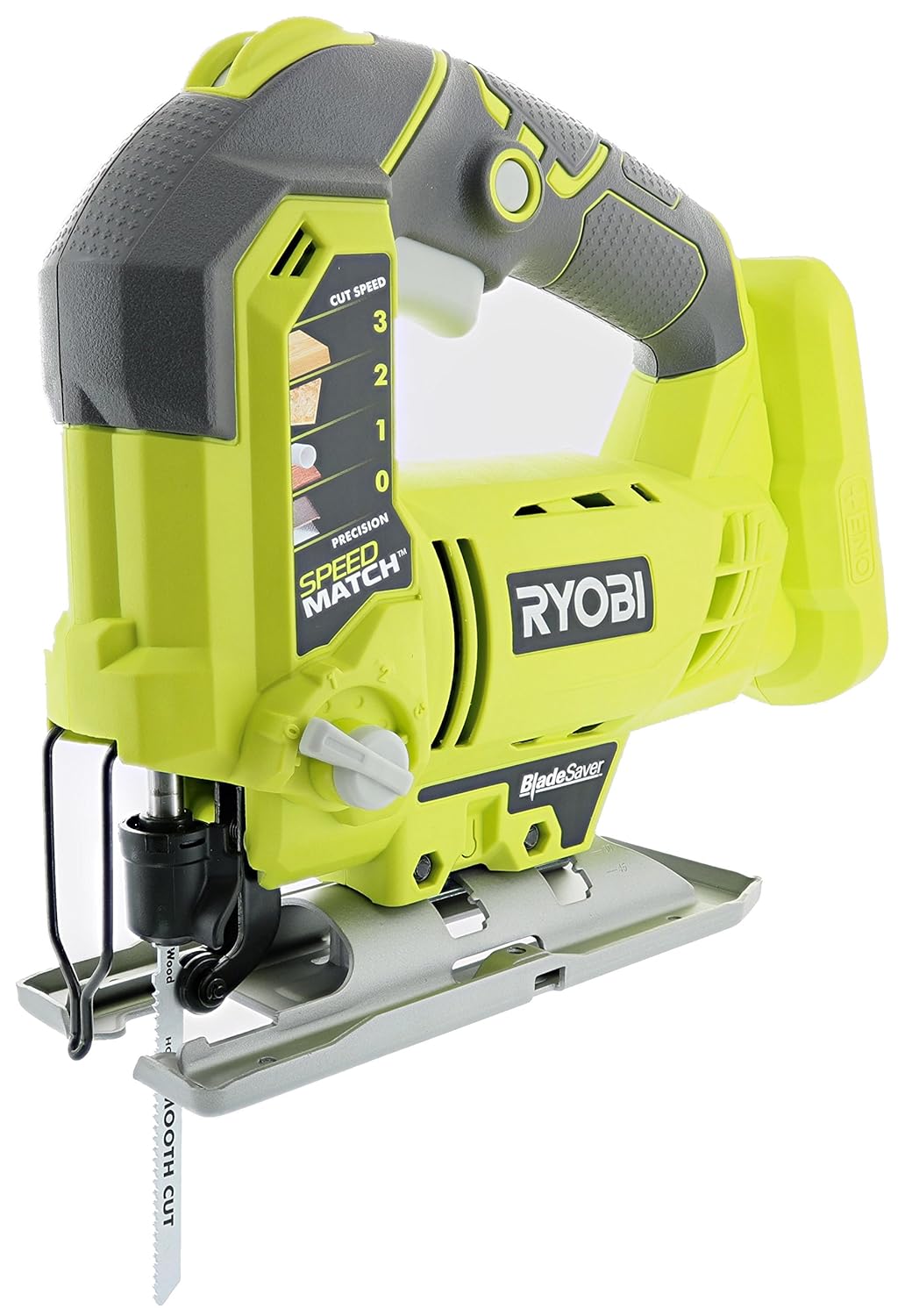
Orbital action pushes the blade forward on the up stroke and pulls it back on the down stroke. In wood it speeds the cut considerably. In metal it should be off entirely, because the sideways loading tears teeth away, and in tight curves it should be off too. Saws with several settings give you the range: the RYOBI P5231 offers four orbital settings from fast straight cuts in wood down to slower work in metal, and the Makita XVJ03Z pairs variable speed with three orbital settings plus a straight cutting mode.
Two habits improve results more than any blade change. Cut with the good face down, because standard blades tear the upward facing surface. And let the blade feed itself rather than pushing hard, since pushing is what deflects the blade and produces a cut that is square at the top and leaning at the bottom.
Safe practice
A jigsaw is among the more forgiving power saws, but the blade is exposed below the workpiece and can break and be thrown. Keep the shoe flat on the material through the cut, since lifting it is the main cause of blade breakage and of the saw jumping.
- Clamp the workpiece. Holding a small offcut by hand puts fingers near an unguarded blade path.
- Know what is under the cut. The blade projects below the material and will reach a bench, a cable or your knee.
- Let the blade stop before lifting the saw off the work.
- Remove the battery or unplug before changing blades, which are hot after cutting metal.
- Wear eye protection. Snapped blade fragments and metal swarf travel.
Plunge cutting by tipping the saw onto the front of its shoe is permitted by some manuals and prohibited by others. Check the manual for your specific saw, and where it is not sanctioned, drill a starter hole instead.
Jigsaws in this catalog
- RYOBI One+ P5231 cordless jigsaw. Brushless with four orbital settings, a dust blower, an LED and a trigger lock. Suits a home user on the One+ battery platform cutting a mix of materials.
- Makita XVJ03Z cordless jig saw. About 6 pounds, with a tool less blade change lever, variable speed and three orbital settings plus straight cutting on a machined base. Suits longer sessions where weight and base flatness matter.
- DEWALT DCS335B 20V MAX jig saw. Brushless and compact, with a variable speed dial and trigger, an all metal keyless blade clamp and a dust blower. Suits close control work with speed set before the cut starts.
The full selection is in the jig saws category. For rough cutting and demolition instead, see what a reciprocating saw is for and the reciprocating saws category.
Frequently asked questions
How is chipping on laminate avoided?
Use a reverse tooth blade so the cutting action pushes down, fit the splinter guard if the saw has one, turn orbital action off and apply low tack tape along the cut line.
Can a jigsaw replace a circular saw?
No. A jigsaw cuts curves and openings, but long straight cuts in sheet goods are more accurate with a guided circular saw, as covered in circular saw versus track saw.