
A track saw cuts straighter with less operator skill, because the blade is captured on a guide rail that clamps to the workpiece and cannot drift off the line. A standard circular saw can produce the same result, but only when it is run against a clamped straightedge and held tight against it for the full length of the cut.
The difference is not motor quality. It is how the cut is referenced. One saw references a pencil line and the steadiness of your hands; the other references an aluminum rail sitting on the cut line.
Key takeaways
- A track saw builds straightness into the setup, so repeat cuts on sheet goods land in the same place each time.
- A circular saw is quicker for framing, decking and rough site work, where getting a rail out costs more time than it saves.
- Both saws use the same blade diameters and the same tooth count logic, so the blade affects edge quality as much as the saw body does.
- Most track saws plunge, which lets you start a cut in the middle of a panel or a fitted worktop.
- Many plunge track saws carry a riving knife behind the blade. A standard circular saw does not, so kickback control there rests entirely on support and technique.
What straightness actually depends on
A handheld circular saw rides on a shoe only a few inches long. Any small angular wobble at the front of that shoe is multiplied over the length of the cut, which is why a freehand rip down an eight foot sheet wanders noticeably even for a careful operator.
A guide rail removes that pivot, because the saw sits in a channel that constrains it laterally and the operator only has to push. A shop-made straightedge closes most of the gap, but it has to be offset by the exact distance from blade to shoe edge, re-measured for each saw and blade, and clamped at both ends so it cannot creep mid cut. The rail approach is repeatable. The straightedge approach is a setup you get right or wrong on every single cut.
Where a circular saw still earns its place
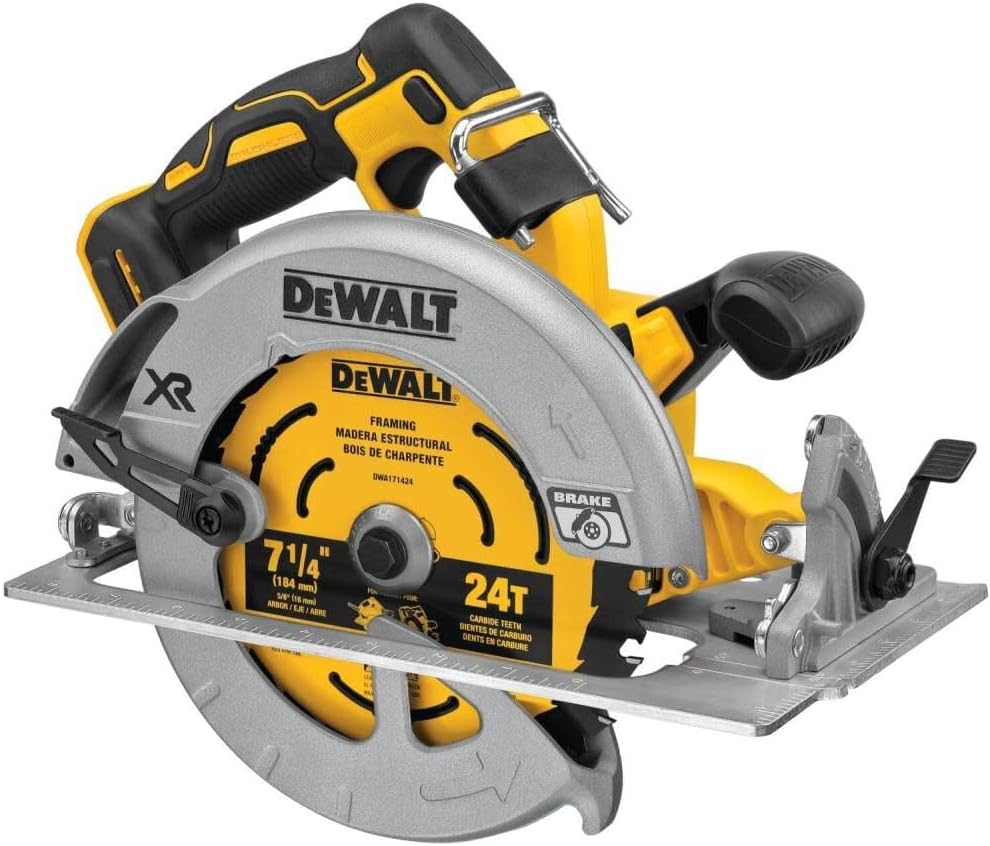
Framing, joists, decking, rafters and sheathing are circular saw work. Cutting capacity in a single pass matters more than a glass smooth edge, and the saw has to go up a ladder or into a crawl space. Depth is the practical limit to check: the DEWALT DCS574B, for example, is rated to 2-9/16 inches at 90 degrees and 2 inches at a 45 degree bevel, which covers common dimensional lumber. Blade availability favors it too, since 7-1/4 inch is the most widely stocked size in every tooth count and grind.
What a track saw adds beyond a straight line
- Splinter control. The rubber strip along the rail edge is trimmed by the blade on first use, after which it sits right at the cut line and backs up the surface veneer.
- Plunge action. You can drop into the middle of a panel, cut an opening in a fitted worktop, or stop a cut short of the end.
- Dust extraction. The blade housing is enclosed and ported. Milwaukee states that its M18 FUEL plunge track saw captures over 90 percent of debris.
- Rail fit. Adjustable cams take slop out of the channel. A loose rail fit is the main reason a track saw stops cutting straight.
Blade choice changes the result more than the badge does
A 24 tooth framing blade will tear plywood no matter which saw carries it, and a 60 tooth plywood blade will bog and burn if you try to rip wet framing lumber with it. Tooth count, grind and kerf decide the edge; the saw decides the line. There is a fuller breakdown in the guide to saw blade tooth count.
One detail applies to both. The teeth exit through the upper face, so tearout appears on the side facing you and the good face goes down. That is the opposite of the rule for the bench machines compared in miter saw versus table saw.
Guarding, kickback and safe setup
Both tools kick back, and both cause serious injuries when they do. Never wedge, tie or hold back the lower guard on a circular saw; let it retract against the material as the cut starts. Set blade projection to roughly a quarter inch below the underside of the workpiece, because extra depth exposes more tooth arc and increases the energy released if the blade binds.
Support both sides of the cut so the offcut cannot close on the blade. Laying a sheet across two sawhorses and cutting between them lets the panel sag and pinch, which is the classic cause of kickback on sheet goods. Rigid foam under the whole panel, or battens under both halves, solves it. Stand to the side of the blade line rather than behind the saw, and wear eye and hearing protection. Guard adjustment, riving knife setting and bevel stops differ between models, so read the manual for your specific machine rather than improvising a procedure.
Saws in this catalog worth comparing
- Makita 5007MGA magnesium circular saw. A 15 amp corded saw rated at 5,800 RPM with dual LEDs and an electric brake, listed at 10.6 pounds. Suits someone doing a lot of framing or deck work who wants a lighter corded saw for all day use.
- DEWALT DCS574B 20V MAX XR circular saw. Cordless with POWER DETECT, an electric brake and an LED, cutting 2-9/16 inches at 90 degrees. Suits a jobsite user already invested in the 20V MAX battery platform.
- WEN CT1065 track saw. A 10 amp corded plunge saw with 45 degree bevel and a dust port. Suits a home shop that mostly breaks down sheet goods and wants rail accuracy without a large outlay.
- Milwaukee 2831-20 M18 FUEL plunge track saw. Brushless, with a quick locking blade change, an adjustable cam for rail fit and a micro-adjust depth knob. Suits an installer cutting finished panels on site where dust matters.
The full range sits in the circular saws category, and the related bench machines are in table saws.
Frequently asked questions
Can a circular saw do everything a track saw does?
Almost. With a clamped straightedge it cuts just as straight, and a fine tooth blade with the good face down handles tearout. It will not plunge into the middle of a panel, and it will not collect dust as well.
Do guide rails fit any brand of track saw?
No. Several brands share a common rail profile and several do not. Check the manufacturer compatibility list for the specific saw before buying rails or connectors from a different brand.
Does a track saw replace a table saw?
For breaking down sheets it often does, and it takes far less floor space. For narrow rips, repeated width settings and dado or joinery work, a table saw is still the more capable machine.
Which one is safer?
A plunge track saw with a riving knife and an enclosed blade exposes less cutting edge. Neither is safe when the workpiece is poorly supported. Follow the manual for the machine you own.