Description
Design and Build Quality
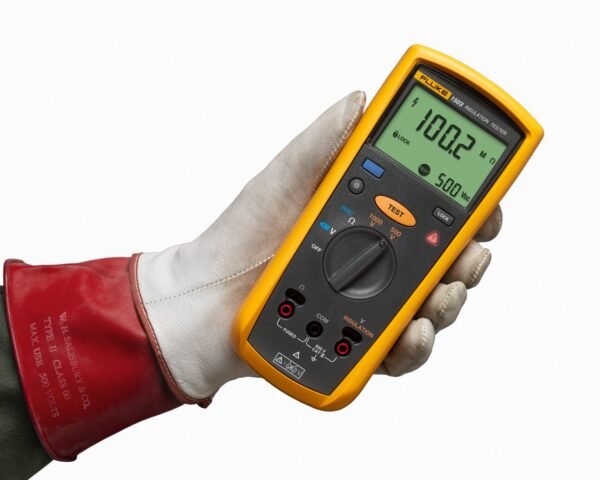
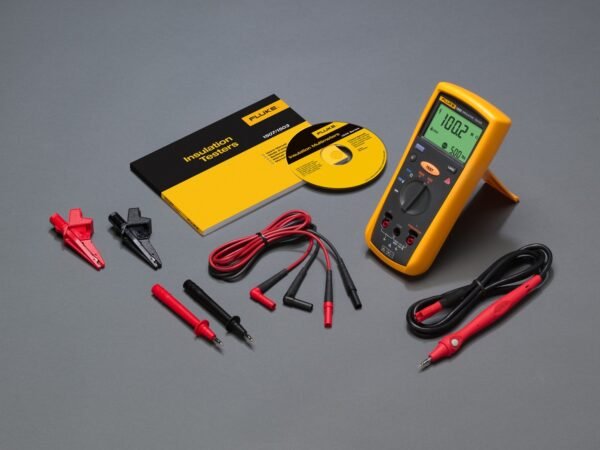
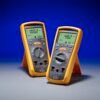
The Fluke 1503 Insulation Resistance Tester leads with solid construction and an ergonomic design. The bright yellow casing is not just for aesthetics; it makes the tester easy to spot in cluttered work environments. Its robust plastic body is durable without being overly bulky, weighing around 500 grams, which strikes a good balance between portability and sturdiness. The large LCD display clearly shows numerical readings and a bar graph, making it easy to interpret results even under poor lighting. The tester includes preset test voltages ranging from 250V up to 5,000V, with adjustable increments available, which offers flexibility for various insulation testing scenarios.
Performance and Features
The performance of this digital megohmmeter is quite comprehensive. It measures insulation resistance up to 1 teraohm (1TΩ), which is sufficient for most industrial and commercial applications. The device doesn’t stop there: it also measures leakage current up to 2 milliamperes, capacitance up to 20 microfarads, and both AC and DC voltage up to 600V. A standout feature is its ability to signal when voltage exceeds 30V, which is a crucial safety alert. The built-in PI/DAR function (polarization index/dielectric absorption rate) automatically calculates these values, offering a more accurate picture of insulation condition than a single-point measurement could. The timed test capability of up to 99 minutes, adjustable in one-minute increments, is what makes long-term insulation analysis practical.
Positive Features
Several aspects of this tester stand out on the spec sheet:
- Wide range of test voltages with both preset and adjustable settings, allowing tailored insulation testing.
- Automatic PI and DAR calculations provide deeper insights into insulation health.
- Data storage for up to 99 test results with PC upload using the included FlukeView Forms Basic software enhances record-keeping and analysis.
- Rated for CAT IV installations up to 600V and CAT III up to 1,000V, supporting safe use in high-energy environments.
- The guard terminal effectively reduces interference from leakage current during high-resistance testing, improving accuracy.
Limitations
Despite its many strengths, the tester is not without its shortcomings:
- The battery system relies on a rechargeable 12V lead-acid battery, which can be bulky and heavier compared to modern lithium-ion packs.
- The software provided is compatible only with older Windows versions like Windows 2000, XP, and Vista, which may pose difficulties for users with newer operating systems.
- Test lead cables could be more flexible; the heavy-duty alligator clips are tough but somewhat rigid, making tight or awkward testing positions a bit challenging.
- The device’s size (approximately 13 x 15 x 3 inches) and weight might be cumbersome if you’re used to smaller handheld insulation testers.
- It lacks a backlight for the LCD screen, which would have been handy for dimly lit environments.
Usability and Safety Features
In terms of ease of use, the tester offers a straightforward interface. The large LCD screen makes readings easy to interpret, and the bar graph is a nice visual aid during tests. Controls are intuitive, with simple buttons to select test voltages and start tests. The unit also has a low-battery indicator and an auto shut-off feature after 30 minutes of inactivity, which helps conserve power. Safety is a key consideration here: the device meets EN safety standards 61010-1 and 61557 and is certified by CSA and TÜV, which is what qualifies it for work on live or potentially hazardous equipment. The high CAT ratings mean it’s suitable for use near the origin of installations and fixed industrial equipment, which is critical for electricians and maintenance engineers.
Comparing to Competitors
Looking at similar insulation testers like the Megger MIT515 or the Kyoritsu 3125, the Fluke 1503 stands out for its extensive voltage range and automatic PI/DAR calculations, features that some competitors either lack or offer only as manual processes. The Megger MIT515, for example, is praised for its ruggedness and ease of use but doesn’t match the Fluke’s maximum test voltage or its detailed data storage capabilities. On the other hand, some rivals offer more modern connectivity options like Bluetooth, which the Fluke 1503 does not have, relying instead on an infrared-to-USB interface for data transfer. If uploading and managing test results on newer operating systems is a priority, some newer models might be more compatible. However, the Fluke’s high safety ratings and broad application range make it a strong contender, especially for users needing trustworthiness in critical environments.
Price Performance
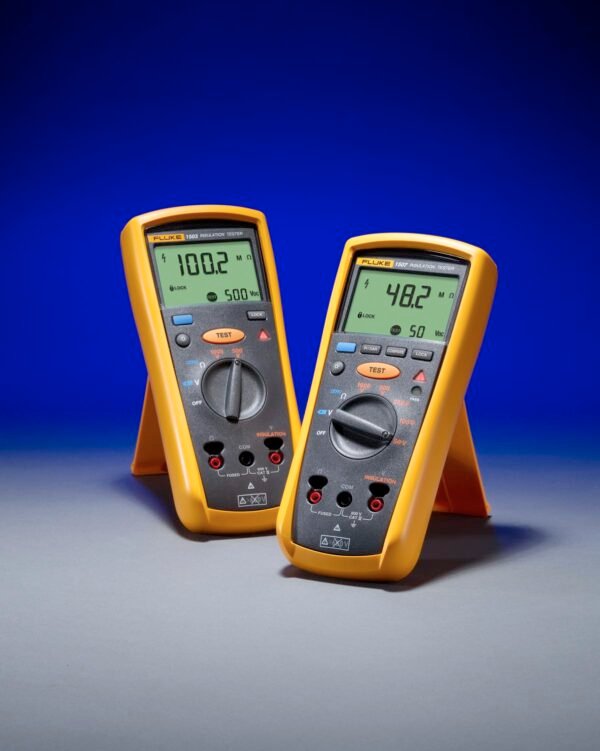
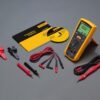
Considering the feature set, build quality, and safety certifications, the Fluke 1503 offers a solid price-to-quality ratio. Although it might not be the cheapest insulation tester on the market, the investment is justified for professionals who demand reliable and accurate measurements in demanding work conditions. The included accessories, meaning test cables, alligator clips, software, rechargeable battery, and carrying cases, add value by reducing the need for additional purchases. Compared to other brands that might skimp on included extras, this tester delivers premium features and durability without feeling overpriced, and the Fluke 1507 insulation resistance tester and the Fluke 179 true RMS multimeter sit alongside it in the same Fluke range. If you’re looking for a device that balances performance, safety, and data management, it’s a smart spending choice.
Practical Use Cases
This tester covers industrial plants, HVAC maintenance, and electrical installation inspections, which is where its versatility shows. The clear voltage warnings and the ability to set custom test voltages in fine increments are what make diagnostics more precise. The guard terminal eliminates false readings caused by stray currents, a feature often overlooked but vital for accuracy. On the downside, carrying the unit all day is not easy given its size, but the hard carrying case provides good protection in transit. Overall, the device’s combination of detailed measurement functions and rugged design make it a dependable tool for both routine checks and detailed troubleshooting.