
A soldering station adds a controlled power base that reads tip temperature and holds it, while a standalone soldering iron plugs into the wall and settles wherever its heating element lands. That single difference drives joint consistency, tip life, and how safely you can work near heat sensitive parts.
Key takeaways
- A station gives closed loop temperature control, a proper stand, and usually a standby mode. A plain iron gives none of those.
- Wattage describes how quickly heat is replaced at the tip, not how hot the tip gets.
- Thermal recovery matters more than peak temperature once you hit ground planes, thick wire, or a shielding can.
- A plain iron still earns bench space for occasional wiring, field repairs, and jobs away from an outlet strip.
What a soldering station actually adds
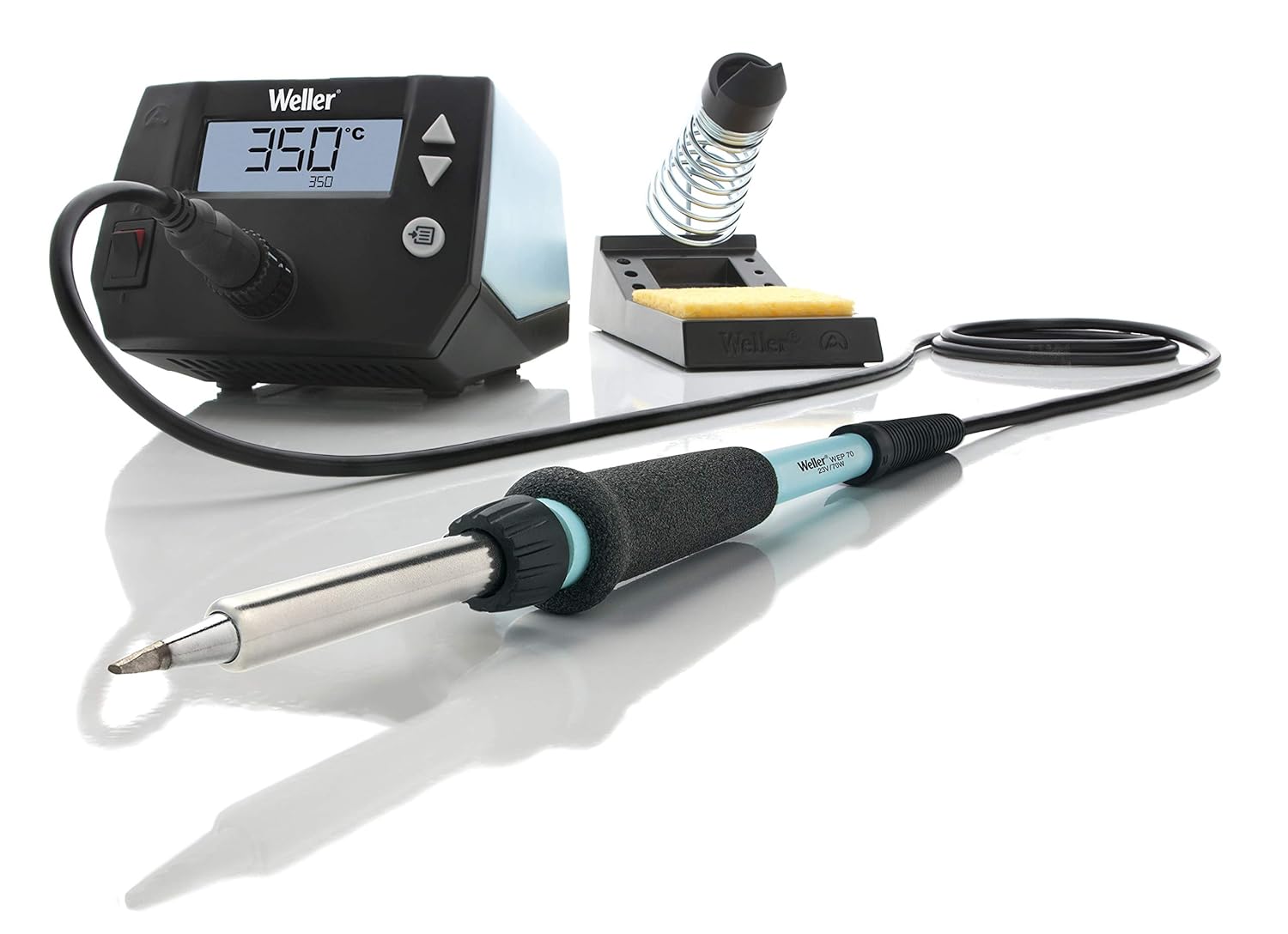
A station is a base unit plus a handpiece. The handpiece carries a temperature sensor near the tip, and the base runs a control loop that compares the reading against the setpoint many times per second, then feeds power to the element as needed. Push the tip into a joint and heat drains away, the base sees the drop and pours power back in. That is the entire value proposition.
Practical consequences follow. You dial a number instead of guessing, which matters because leaded and lead free solder want different working temperatures, and you get repeatability across sessions. Most stations add a standby or setback mode that drops the tip toward a low idle temperature after a few minutes in the cradle, which slows the oxidation that kills tips. Better units let you calibrate the display against a tip thermometer, because sensors drift with age. The base also holds the iron in a metal cradle instead of leaving a 350 degree Celsius tip loose on a bench. Browse the soldering stations category to see how feature sets differ.
Where a plain soldering iron still makes sense
A standalone iron is a heating element, a tip, and a handle. Nothing measures the tip, so its temperature is whatever equilibrium the element reaches against the mass of the tip and the heat lost to air. Idle, that number often overshoots what electronics work wants, and under load it sags.
None of that rules the format out. Splicing automotive wiring, tinning a battery tab, or soldering a connector in a crawlspace are jobs where a simple iron is quicker to deploy and cheaper to risk. Field work is the strongest case, and some modern portable irons blur the line by putting the control electronics into the handle itself. The compromise most people land on is two tools: a controlled station on the bench, and a basic or portable iron in the toolbag. Compare formats in the irons category.
Wattage, temperature and recovery are three different things
Buyers conflate these. Temperature is the setpoint at the tip, commonly 315 to 370 degrees Celsius for leaded solder and 340 to 400 for lead free alloys. Wattage is the reservoir of power available to defend it. Recovery is how fast the system restores it under load.
A 40 watt uncontrolled iron and a 70 watt station can idle at the same tip temperature, then behave nothing alike on a copper pour. The 40 watt iron slumps, so the operator waits, presses harder, and cooks the pad while the joint still refuses to wet. The station drops briefly and climbs back, so solder flows and the tip leaves within seconds.
Tip geometry belongs in the same conversation. A chisel tip carries far more heat into a joint than a fine conical tip at the same setpoint, simply because it makes more contact, so reaching for a bigger tip solves more heating complaints than raising the dial does. The soldering temperature guide covers setpoints and tip care in detail.
Soldering guns and desoldering tools
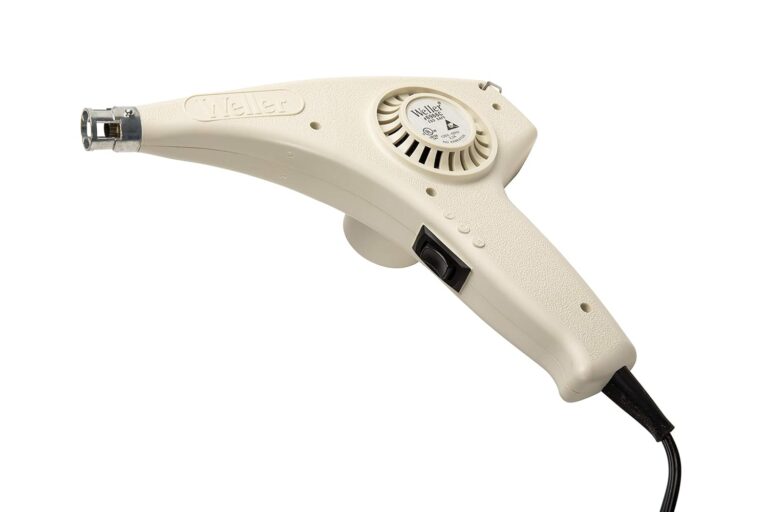
A soldering gun is a transformer in a pistol grip that dumps current through a loop of tip wire. It reaches working heat in seconds and puts serious energy into heavy gauge wire and chassis grounds, but it is crude, nose heavy, and unsuited to circuit boards. Desoldering is separate again: braid and a plunger pump cope with simple through hole parts, while a powered vacuum desoldering tool clears plated through holes far more cleanly and saves multilayer boards from lifted pads.
Working safely at the bench
Flux fume is the routine hazard, not the solder itself. Rosin smoke is a recognised respiratory sensitiser, so use fume extraction or at minimum an open window with a small fan pulling the plume sideways away from your face. With leaded solder, keep food and drink off the bench and wash your hands before eating. Tips ignite paper and melt cable insulation on contact, so return the iron to its cradle every time it leaves your hand. Follow the instructions supplied with your own station or iron, since standby behaviour, tip fitting, and calibration differ by model. Afterwards, a continuity check confirms the joint, and the walkthrough on how to use a multimeter covers that test.
Options from this catalog
- Weller WE1010NA digital station: 70 watts, stability quoted at plus or minus 2 degrees Celsius, with auto standby, setback, and password protected settings. Suits a shared bench where settings must stay put, though it ships as station only in a plastic housing.
- YIHUA 939D+ digital station: roughly 392 to 896 degrees Fahrenheit, with a Celsius and Fahrenheit toggle, calibration support, ESD safe design, and standby on handle detection. A sensible first digital station.
- Weller WLC100 analog station: a dial varying power from 5 to 40 watts, plus an ST3 iron plated tip, holder, and sponge. Suits light hobby work, but with no digital readout you estimate heat from a wattage dial.
- FNIRSI HS-02B portable iron: a 100 watt corded pencil adjustable across 212 to 842 degrees Fahrenheit, with three tips and a case at about 2.4 ounces. Good for field repair, provided you accept it still needs its supplied adapter.
For heavy gauge work rather than boards, the Weller D550 soldering gun is the relevant format, with dual 200 and 260 watt settings on a trigger and a quoted six second heat up.
Frequently asked questions
Can a plain soldering iron handle circuit boards?
It can, and hobbyists did so for decades. The risk is an uncontrolled tip drifting hotter than the board wants, lifting pads and cooking flux before the joint wets. A modest controlled station removes most of that risk.
Is higher wattage always better?
No. Wattage sets how fast heat is replaced, and a controlled station only draws what the loop calls for. A high wattage uncontrolled iron simply gets hotter, which is the opposite of what fine work needs.
Is a separate desoldering station necessary?
Only if you remove parts often. Braid and a manual pump cope with occasional through hole work. Combination units that pair a soldering iron with a vacuum desoldering gun exist if bench space is tight.
What about flux?
Cored solder wire carries flux, but rework and repair usually need extra. Which chemistry you choose changes whether residue must be washed off, and the guide to soldering flux types walks through the differences.