
A UV flashlight is a detection tool, not a light source. It makes certain materials fluoresce so you can find things ordinary white light will not show: pet stains on carpet, refrigerant and coolant leaks traced with UV dye, security features on banknotes and documents, scorpions at night, minerals, and the coverage of cleaning or coatings.
Key takeaways
- UV flashlights emit UV-A, roughly 315 to 400 nanometres. The useful wavelength is 365nm. The cheaper 395nm lights spill a lot of visible violet, which washes out the contrast you are looking for.
- UV is for finding things, not lighting the way. It will not illuminate a path.
- Common uses are leak detection with dye, pet stains, currency and document checks, mineral hunting, resin curing and hygiene inspection.
- Wear UV blocking eyewear for extended use, never look into the emitter, and do not shine it at people or animals. Follow the manufacturer’s safety instructions.
- These lights emit UV-A. They are not germicidal UV-C and should never be used or described as disinfection tools.
How a UV flashlight actually works
Fluorescence is the trick. Certain substances absorb ultraviolet energy and re-emit it at a longer, visible wavelength, so they glow while everything around them stays dark. Urine salts, some detergents and optical brighteners, tonic water, many minerals, and the security fibres in banknotes all do this.
The catch is contrast. The glow is faint, so any visible light the torch leaks reduces what you can see. That is why the purple haze from a cheap UV light is a problem rather than a feature. Better lights fit a filter over the emitter, commonly ZWB2 glass, to block visible output and pass the ultraviolet.
365nm versus 395nm
This is the single specification that matters most. A 395nm emitter is cheaper and puts out a bright violet glow that your eye sees directly. A 365nm emitter sits further from visible light, so far more of what you see is genuine fluorescence.
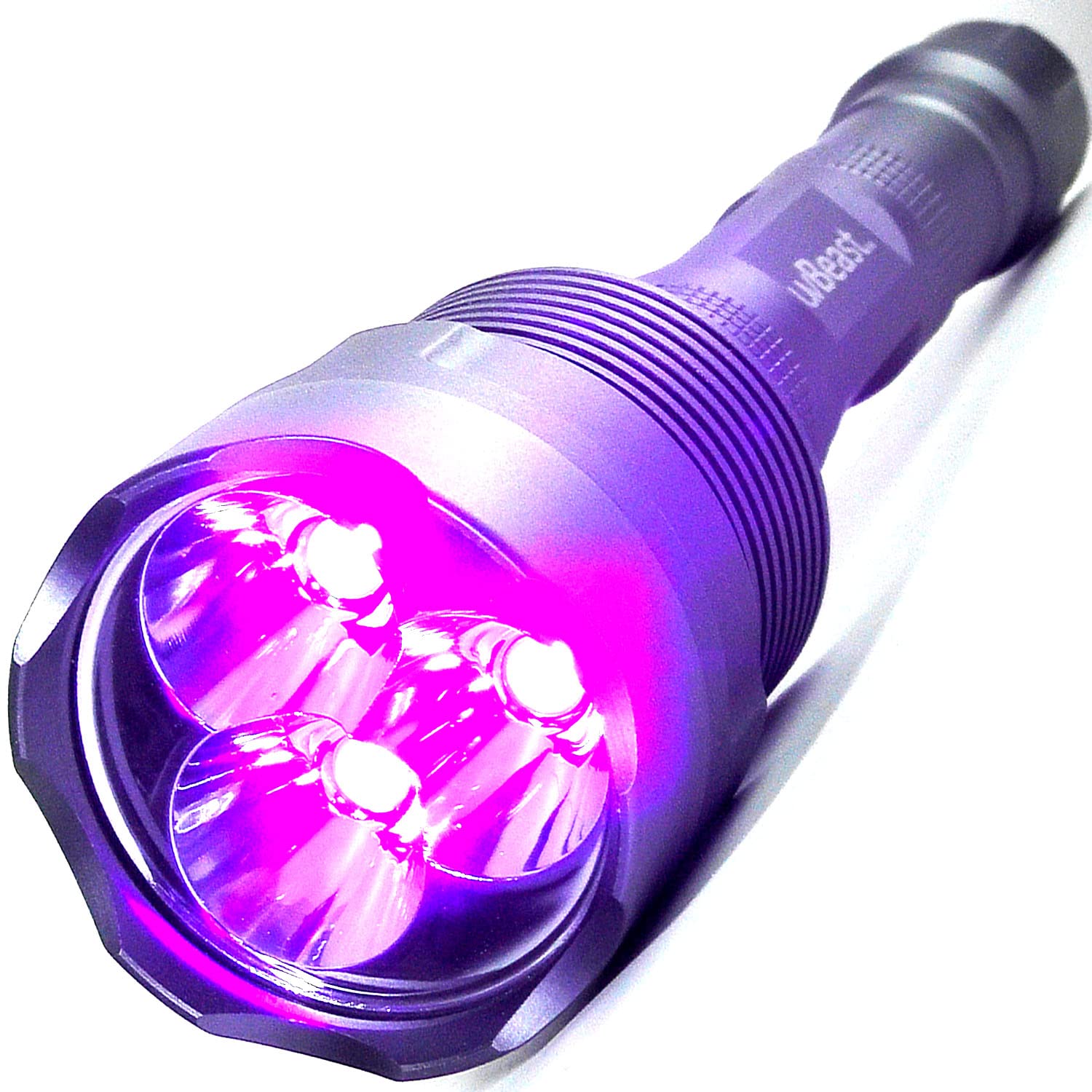
The catalogue shows both approaches. The JETBeam E26 runs a 365nm UV source rated up to 1300mW. The OLIGHT Arkfeld Pro uses 365nm at 900mW, described in its review as noticeably stronger and purer than the 395nm lights that dominate the low end. The uvBeast V3 takes the other route, using a 385 to 395nm broad band with three 1.2A LEDs to brute force the output, with a stated beam throw of more than 70 feet.
Both approaches work. For close inspection with clean contrast, look for 365nm. For covering a large area at distance, raw output starts to count.
What people actually use them for
- Leak detection. HVAC and automotive work uses a UV tracer dye added to refrigerant, coolant or oil. The dye glows at the leak point, which is often the only way to find a slow seep. Follow the dye manufacturer’s instructions for dosing and for which systems it is approved in.
- Pet stains. Dried urine fluoresces, so a UV light finds the areas a carpet cleaner missed. The BORUIT V10 review lists this among the uses for its 365nm mode.
- Currency and document checks. Banknotes from most countries carry fluorescent security threads and printed marks. A UV light shows whether they are present. It does not by itself authenticate anything.
- Minerals and collecting. Fluorite, calcite, scheelite and others glow strongly under UV, which is a large hobby in its own right.
- Scorpions and night spotting. Scorpion cuticle fluoresces bright blue green, which is why UV lights are standard kit in parts of the world where that matters.
- Resin curing. UV cure resins and adhesives set under 365nm output, which the JETBeam E26 review mentions.
- Hygiene and coverage checks. Many cleaning products contain optical brighteners, so UV shows where the cloth did and did not reach.
Safety and eye protection
UV-A is lower energy than the UV-B and UV-C bands, but a high output UV torch held close to the eye is still worth respecting. Sensible practice is straightforward.
- Never look directly into the emitter, and never point it at anyone’s face or at pets.
- Wear UV blocking eyewear for sustained inspection work. The uvBeast V3 is supplied with UV optic glasses precisely because it is aimed at professional use.
- Keep exposure to bare skin brief with high output units, follow the manufacturer’s stated limits for that model, and store it away from children.
One point worth stating plainly: the UV-A output of these flashlights is not the germicidal UV-C used in disinfection equipment. Do not treat a UV flashlight as a sterilising device.
Dedicated UV light or a combination light?
If UV is an occasional need, a combination light makes more sense than a second torch to carry. The OLIGHT Arkfeld Pro pairs 1300 lumens of white light with a green beam and its 365nm UV mode, selected with a circular switch. The JETBeam E26 does something similar with 2000 lumens of white, a green beam capped at 45mW in class 3R, and UV, in an IP68 rated body. Even the keychain sized Fenix E06R includes a UV output alongside its 700 lumen white light.
If UV inspection is the job rather than a bonus, a dedicated unit gives more output and a beam shaped for it. That is the uvBeast V3’s case, at the cost of 377 grams and a fixed focus.
Four UV capable lights in the catalogue
All four sit in the handheld flashlights category.
- uvBeast V3: a dedicated UV unit with three 1.2A LEDs at 385 to 395nm, a stated throw beyond 70 feet, roughly 4 hours per charge and UV glasses supplied. Suits inspection and leak detection work. It weighs 377 grams and the beam is fixed.
- JETBeam E26: 2000 lumens of white, a green beam and 365nm UV up to 1300mW in an IP68 body around 5 inches long. Suits someone who wants one light for general use and occasional UV. The battery is built in and cannot be swapped.
- OLIGHT Arkfeld Pro: a flat carry light with 1300 lumens white, a green beam and 365nm UV at 900mW, plus a five level battery indicator and up to 55 hours on its lowest setting. Suits pocket carry where UV comes up now and then.
- BORUIT V10: a sub 50 gram keychain light with a 1000 lumen main output and a 365nm UV mode, charging over USB-C in about 2.5 hours. Suits casual checks. The IPX4 rating covers splashes only, so keep it out of the wet.
FAQ
Will a UV flashlight show every stain?
No. It shows materials that fluoresce. Dried urine, some detergents, certain oils and dyes will glow, while plenty of ordinary dirt and many stains will not react at all.
Is 395nm useless then?
Not at all. It works well for banknote checks, UV tracer dyes and strongly fluorescent targets. It simply gives less contrast than 365nm because you are also seeing the violet light directly.
Do I need UV glasses?
For brief checks around the house, no, provided you never look into the emitter. For sustained inspection work with a high output unit, UV blocking eyewear is standard practice and some units are supplied with it.
Can I use a UV flashlight for lighting?
No, which is why combination lights exist. The white light side of the decision is covered in how to choose a flashlight and in lumens explained, while the EDC flashlight guide covers carrying one daily.