
A CAT rating tells you how much transient energy a test instrument is built to survive, and it always appears as a category paired with a voltage, such as CAT III 600V. The category matters more than the voltage number, because it describes the position in the electrical system where the meter can be connected without the risk of a violent failure.
Key takeaways
- Categories run from CAT I to CAT IV, and the number rises as you move closer to the utility supply, where available fault energy is highest.
- A higher voltage on a lower category is not an upgrade. CAT III 600V withstands more transient energy than CAT II 1000V.
- The rating applies to the whole assembly. Leads, probes, clips and adapters all need to meet the same category or they become the weak link.
- Look for an independent listing mark, since a category printed on a case is a manufacturer claim until a test house has verified it.
- Choosing the right category is a matter of matching the tool to the work, and work on energised distribution circuits belongs with a qualified electrician.
What the categories actually mean
The IEC 61010 standard divides the electrical world into four measurement categories based on how far a point sits from the incoming supply, and therefore how much energy a voltage spike can carry at that point.
- CAT I. Protected electronic circuits that are not connected to mains, such as signal level circuits inside equipment powered by a supply with its own protection. Rarely printed on general purpose handhelds.
- CAT II. Single phase loads plugged into an outlet. Appliances, portable tools, plug in receptacle testers and cord connected equipment sit here.
- CAT III. Fixed distribution wiring inside a building. Panelboards, feeders, busbars, hard wired equipment and lighting circuits in commercial buildings sit here.
- CAT IV. The origin of the installation. Service entrance conductors, the supply side of the main disconnect, meter sockets and outdoor drops sit here.
The reason the ladder exists is impedance. Deep inside a building, wiring and transformers damp a surge. At the service entrance there is very little between the conductor and the utility, so a lightning strike or a switching transient arrives with far more energy behind it.
Why the voltage number is the second question
Testing under the standard applies a defined impulse to each category, and the impulse gets larger as the category climbs. That is why a CAT III 600V instrument faces a harsher transient test than a CAT II 1000V instrument, even though the second displays a bigger number. Buyers who read the voltage figure and stop there have inverted the safety logic entirely.
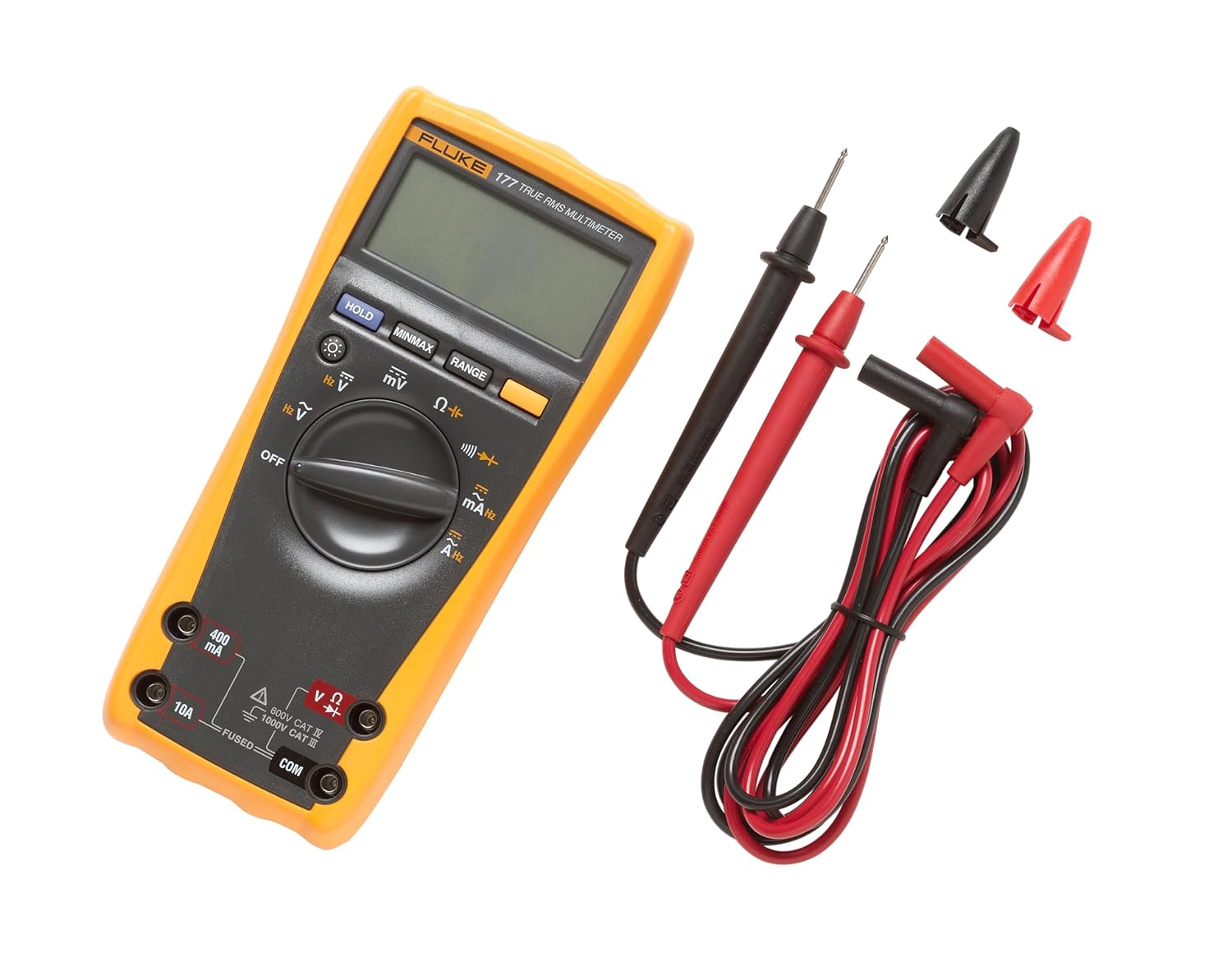
Some instruments carry two ratings at once. The Fluke 177 True RMS multimeter is listed as CAT IV 600V and CAT III 1000V. That pairing is normal for a heavier duty design and reflects the same underlying idea: as the working voltage rises, the category the instrument can hold falls.
How the ratings look across real instruments
Ratings in the catalog span the range, and the pattern follows the intended job rather than the price alone.
- The Klein Tools RT250 GFCI outlet tester is rated CAT II 135V. That is appropriate, because a receptacle tester is a plug in device that never leaves the outlet.
- The Klein Tools ET310 breaker finder transmitter is rated CAT II 120V and is specified for 120V circuits only, which limits it to standard North American receptacles.
- The Fluke 115 and the Extech EX330 both sit at CAT III 600V, which covers panel and distribution work in most residential and commercial buildings.
- The Fluke T5-600 electrical tester is rated CAT III 600V, matching the panel level work its OpenJaw current function is aimed at.
A CAT II receptacle tester and a CAT III handheld are not interchangeable even though both display voltage, and using the lower rated tool outside its intended position is where the risk sits.
Leads, probes and the weakest link problem
The category on the meter body only holds if everything attached to it meets the same standard. Replacement leads bought on price, adapters carried over from an older instrument, and clips with damaged insulation all pull the assembly down. Probe tip length matters too, since long exposed tips make accidental bridging between adjacent terminals far easier, which is why several instruments ship with shrouded or shortened tips such as the detachable SlimReach probes supplied with the Fluke T5-1000.
Accessory lead sets should state a standard on the packaging. The AstroAI lead kit lists compliance with IEC and EN 61010, and that marking is the minimum to look for before a lead goes near a live circuit.
Independent listing marks
A printed category is a claim. A listing mark from a recognised test laboratory means a third party has verified that the instrument passed the impulse and clearance tests for that category. The Extech EX330 carries a UL listing alongside its CAT III 600V rating, and the Innova 3320 is UL certified. Where no such mark appears, treat the category as unverified.
Instruments in this catalog by category
- Fluke 177. CAT IV 600V and CAT III 1000V with True RMS and closed case calibration. Suits professionals who work at or near service entrance level and want the highest category in the catalog, accepting the weight and the separate temperature accessory.
- Fluke 115. CAT III 600V, True RMS, 6000 count backlit display. Suits field technicians doing panel and equipment troubleshooting who do not need CAT IV.
- Extech EX330. UL listed CAT III 600V in a compact body with a built in non contact detector. Suits homeowners and hobbyists who want a properly rated meter without the bulk, though the supplied leads are its weak point.
- Klein Tools RT250. CAT II 135V receptacle tester with an LCD readout and GFCI trip time display. Suits outlet checks only, and it should never be treated as a panel level instrument.
Fuller listings sit under multi testers and voltage testers. Before buying on category alone, it is worth reading how to use a multimeter safely and, if AC waveform accuracy matters, true RMS explained.
FAQ
Which category does a homeowner need?
For outlet level checks on cord connected equipment, CAT II covers the work. Opening a panel needs CAT III as a minimum, and that work belongs with a qualified electrician.
Can a CAT III meter be used on a CAT IV circuit?
No. The transient energy available at the service entrance is what the CAT IV impulse test simulates, and a CAT III instrument has not been qualified against it. Step up the category rather than hoping the voltage number covers it.
Does the CAT rating cover a non contact tester?
Those tools carry their own ratings, but the question differs because they never make contact. Their real limitation is false negatives, covered in the guide to non contact voltage testers.
Do CAT ratings expire?
The rating does not, but the instrument can degrade. Cracked cases, damaged leads, substituted fuses and moisture ingress all compromise the clearances the rating depends on, so damaged equipment should be retired rather than taped up.