
A voltage tester answers whether voltage is present, while a multimeter tells you how much of it there is along with resistance, current and a spread of other quantities. Most electricians end up carrying both, because the tester is quicker for the checks that happen dozens of times a day and the meter is the only one of the two that can actually diagnose a fault.
Key takeaways
- Testers are built around speed and a small number of clear indications. Meters are built around numeric measurement across many functions.
- Two wire solenoid and digital testers make contact with the conductor. Non contact pens do not, and they carry a very different failure mode.
- Low impedance testers are less prone to ghost voltage than a high impedance multimeter, which is a real advantage on long parallel cable runs.
- Hybrid electrical testers combine a tester form factor with a clamp jaw and a numeric display, covering a large share of everyday checks.
- Neither tool substitutes for training. Work on energised circuits belongs with a qualified electrician following the manufacturer instructions for that instrument.
What a voltage tester is designed to do
The category covers several distinct tools. Two wire testers, solenoid types and simple digital testers make direct contact with a conductor and indicate presence, rough magnitude and often whether the supply is AC or DC. Receptacle testers plug into an outlet and report the wiring configuration. Non contact pens sense the electric field around a conductor and give an audible or visual alert without touching anything.
What unites them is that the answer arrives fast and requires no dial setting. A tester used a hundred times in a shift has to be one handed, unambiguous and hard to set up wrongly.
What a multimeter adds
A meter turns presence into a number and adds functions a tester cannot provide. Resistance readings identify open windings and damaged heating elements, continuity confirms a conductor path end to end, capacitance checks motor run capacitors, and a thermocouple input pulls the instrument into HVAC work.
The Klein Tools MM420 illustrates the breadth. One auto ranging True RMS instrument covers voltage and current to 600V and 10A, resistance to 50 MegOhms, plus continuity, temperature, capacitance, frequency, duty cycle and diode testing. No tester in any format comes close to that list.
Input impedance and ghost voltage
This is the technical difference that surprises people moving from a tester to a meter. Digital multimeters present a very high input impedance, typically around 10 MegOhms, so they draw almost no current from the circuit. That is what makes them accurate on sensitive electronics, and the Innova 3320 lists its 10 MegOhm input impedance specifically to avoid loading automotive control modules.
The side effect is that a high impedance input will happily display a voltage induced by capacitive coupling from an adjacent energised conductor. This ghost or phantom voltage is real in the sense that the meter is not broken, and misleading in the sense that the circuit has no meaningful source behind it. Solenoid and low impedance testers load the circuit enough to collapse that induced reading. Some meters offer a switchable low impedance mode for the same purpose, such as the LoZ function on the Klein Tools CL800.
None of this changes the underlying rule. A low or absent reading on any instrument is not proof that a conductor is safe to touch, and establishing that is a formal procedure carried out by a qualified person.
The hybrid electrical tester
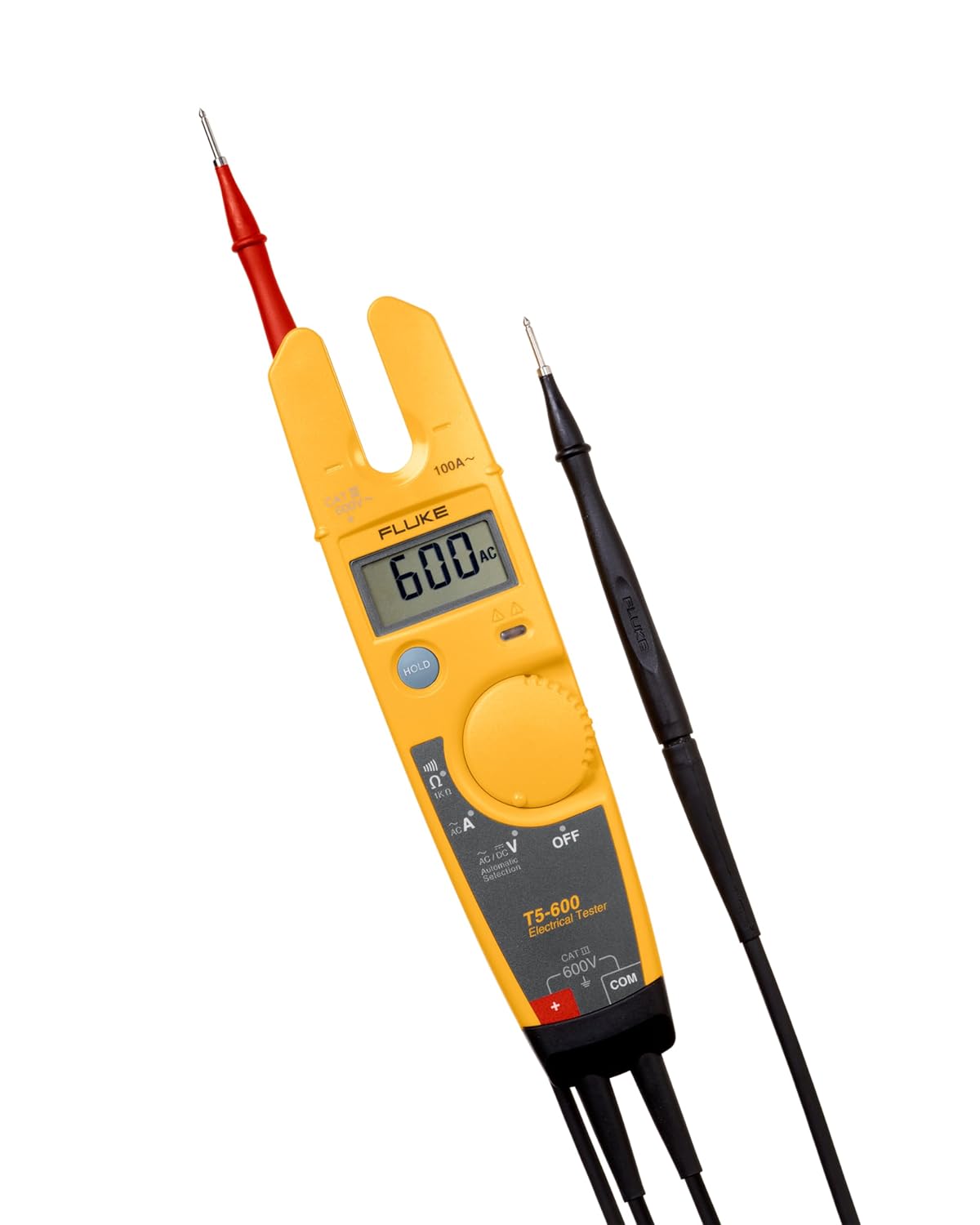
Between the two categories sits a class of tool that borrows from both. The Fluke T5-600 automatically detects AC or DC voltage up to 600V, tests continuity below a 25 ohm threshold, and reads current up to 100A through an OpenJaw slot that never requires breaking the circuit. It is rated CAT III 600V and specified to survive a 10 foot drop. Its resistance range tops out at 1000 ohms and the display has no backlight, so it is a tester with numbers rather than a full meter.
The Fluke T5-1000 extends the same idea to 1000V working voltage with detachable SlimReach probe tips and integrated lead storage. Its 66 Hz bandwidth marks the boundary of what it is for, which is fundamental mains work rather than waveform analysis.
Choosing between them by task
A short mapping covers most decisions. Confirming a receptacle is wired correctly is a receptacle tester job. Confirming voltage presence before opening a fixture is a contact tester job, with a non contact pen used only as a first pass and never as the final word. Measuring how far a supply has sagged under load, tracing a resistance fault or checking a capacitor is a multimeter job. Reading current draw without opening the circuit is a clamp job, whether that is a dedicated clamp meter or the jaw on a hybrid tester.
Tracing a circuit back to its breaker is neither, and needs a transmitter and receiver pair as described in how to find which breaker controls an outlet.
Options in this catalog
- Fluke T5-600. CAT III 600V tester with OpenJaw current to 100A, continuity and a 10 foot drop rating. Suits electricians who want one pocket tool for presence, continuity and current, and who can live without a backlit display.
- Fluke T5-1000. The same OpenJaw approach at 1000V working voltage with detachable SlimReach probes and onboard lead storage. Suits commercial and industrial work above 600V, though the probe tips are more delicate than a rugged fixed design.
- Klein Tools RT250. A CAT II 135V receptacle tester with a backlit LCD, GFCI trip time display and open neutral and open ground detection. Suits outlet inspection work, with the practical annoyance that it runs on uncommon AAAA cells.
- Fluke 115. A CAT III 600V True RMS multimeter with a 6000 count backlit display and min, max and average recording. Suits anyone who needs actual diagnosis rather than presence checks, accepting that it is heavier than pocket meters and has no stand.
The wider ranges sit under voltage testers and multi testers.
FAQ
Can a multimeter replace a voltage tester entirely?
Functionally it covers the same ground, but it is slower to deploy and its high input impedance makes ghost voltage more likely. Many electricians keep both rather than choosing one.
Is a non contact pen enough on its own?
No. Shielding, conduit, burial depth, insulation thickness and battery condition can all cause a pen to stay silent on a live conductor. The limits are set out in the guide to non contact voltage testers.
Which one should a homeowner buy first?
For checking outlets and appliance cords, a receptacle tester plus a basic rated multimeter covers most of what a homeowner can legitimately do. Anything requiring the panel to be opened should go to a licensed electrician.
Do testers need a CAT rating too?
Yes, and the categories differ sharply between tools. A receptacle tester rated CAT II 135V is not interchangeable with a CAT III 600V handheld. The full explanation is in multimeter CAT safety ratings, and general handling is covered in how to use a multimeter safely.