
A clamp meter measures the current flowing in a conductor without breaking the circuit, by reading the magnetic field around a single wire. That is the one measurement a standard multimeter cannot make conveniently or safely once the current rises past a few amps.
Everything else on a modern clamp meter, voltage, resistance, continuity, capacitance and temperature, is a multimeter function bolted onto that jaw. Knowing what the jaw can and cannot do separates a useful reading from a misleading one.
Key takeaways
- The jaw must go around one conductor only. Clamp a two conductor cord and the reading is zero, because the outgoing and returning currents cancel.
- Current transformer jaws read AC only. Hall effect jaws read AC and DC and need zeroing first.
- True RMS matters on anything driven by an inverter, a drive or a dimmer, where an averaging meter reads low.
- A clamp meter is not a substitute for proving a circuit dead with a two pole tester and a proving unit.
- The CAT rating and voltage rating must match the installation being worked on.
How the jaw reads current
Current flowing in a wire creates a magnetic field around it. The jaw is a split iron core that closes around the conductor and concentrates that field into a sensing element. Nothing touches the conductor and the circuit is never opened, which is why a clamp meter can read a running motor or a live feeder.
Two sensing technologies dominate. A current transformer jaw uses the changing field of alternating current to induce a proportional current in a secondary winding. It is simple and accurate, and blind to direct current, because a steady field induces nothing. A Hall effect jaw responds to field strength itself, so it reads both AC and DC, and it drifts slightly with temperature, which is why it carries a zero button to press with the jaws closed and empty before a DC reading.
Jaw geometry decides what you can get around at all, so check the stated opening against your largest conductor. The Fluke i410, for example, fits conductors up to 30 mm while reading AC and DC to 400 amps.
Why the reading is zero, and other jaw mistakes
The most common error is clamping around a complete cable. In a two conductor flex the line and neutral carry equal and opposite currents, their fields cancel, and the meter reads close to nothing. The fix is to separate a single conductor, or to use a line splitter accessory.
Position matters too. Center the conductor in the jaw and close the jaw fully so the core mates, since a dirty or open mating face reads low. Used deliberately, that cancellation is a diagnostic: clamping every conductor of a circuit at once should read close to zero, and anything significant is current returning by another path, which is one way earth leakage gets found.
What a clamp meter cannot do
- Read DC current on a transformer only jaw. If the specification lists AC current with no DC range, the jaw physically cannot do it.
- Resolve small currents on a large jaw. A 600 amp jaw reading a few milliamps is asking too much. Milliamp work needs a process clamp.
- Read current inside an intact cable. One conductor has to be accessible.
- Measure insulation resistance. That needs a dedicated tester applying hundreds of volts.
- Prove a circuit dead on its own. Use a two pole tester and a known live source before and after, as covered in voltage tester versus multimeter and non contact voltage testers.
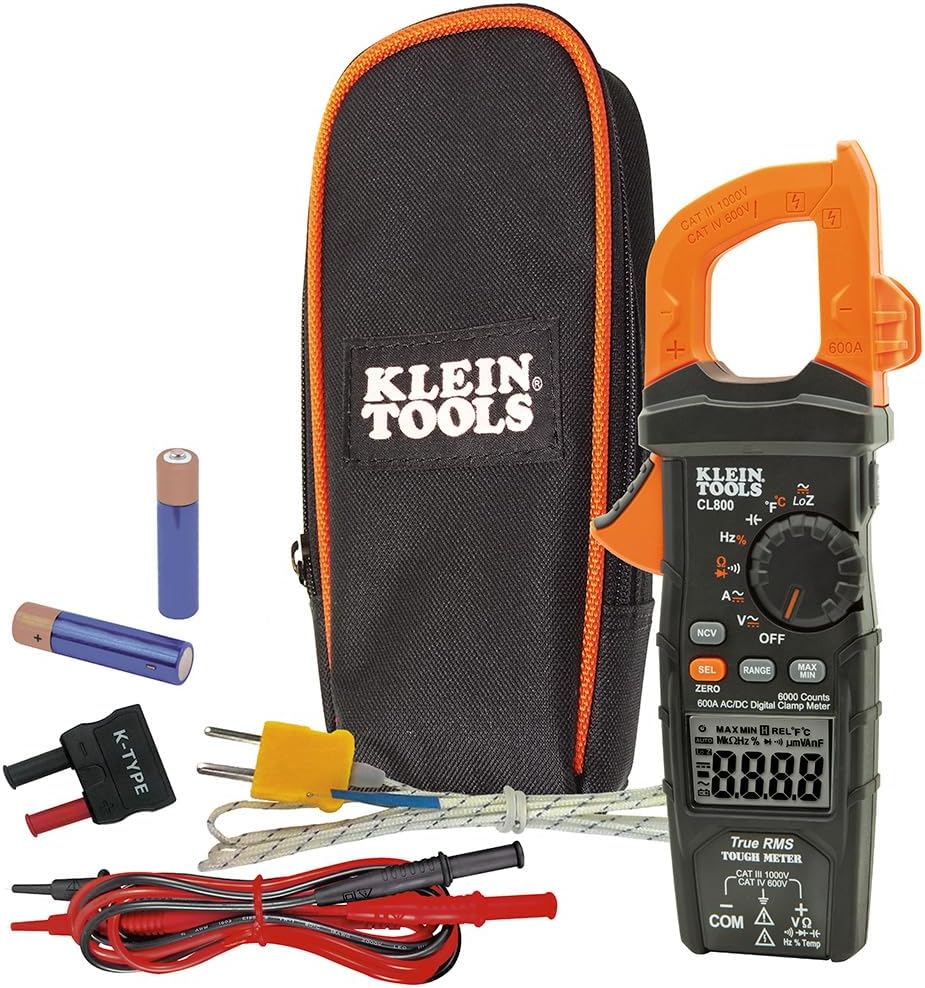
Ghost voltage is a subtler trap. Capacitive coupling in a conduit shows a reading on a high impedance voltage input when nothing is energized, and low impedance modes dump it. Klein describes the LoZ mode on models such as the CL800 as eliminating those false readings.
Jaw types and the meters built around them
Rigid jaw. The familiar shape. Robust and accurate, limited by how wide it opens and how much room there is in the panel to swing it.
Flexible coil. A rope shaped sensor that wraps around a busbar or a bundle where a rigid jaw will not fit. These read AC only and are typically less accurate at the low end, but they solve access problems nothing else can.
Milliamp process clamp. A specialized jaw for 4 to 20 mA control loops. The Fluke 773 is built for this, reading the loop without breaking it at a stated 0.2 percent accuracy, with a detachable clamp for cramped enclosures.
Safety ratings and working practice
The CAT rating on the meter and its leads describes the transient energy the instrument is built to survive at a given point in an installation. It rises from CAT II at socket outlets through CAT III at distribution boards to CAT IV at the service entrance, and the voltage figure beside it is part of the rating rather than a separate number. Meter and leads both have to meet the category for the work, as covered in the guide to multimeter CAT ratings.
Current measurement with a clamp is work on or near live equipment, the highest risk category of electrical work. Follow local regulations and your employer’s procedures. Isolate wherever the measurement allows, use insulated tools and protective equipment, inspect leads and the meter body before every use, and do not work alone in a live panel.
True RMS is the specification to look for on modern loads. An averaging meter assumes a clean sine wave and reads low on the distorted current drawn by drives, LED lighting and switch mode supplies. The reasoning is set out in true RMS explained, and general meter technique in how to use a multimeter.
Clamp meters in this catalog
- Klein Tools CL800. Auto ranging true RMS on AC and DC, LoZ mode, backlit display, IP40 and rated for drops to 6.6 feet. Suits an electrician wanting one meter for most panel work.
- Klein Tools CL390. Auto ranging true RMS with a reverse contrast display and non contact voltage detection built into the jaw. Suits someone wanting voltage sensing and current measurement in one hand.
- Fluke i410 current clamp. AC and DC to 400 amps with a zero adjustment, fitting conductors to 30 mm and connecting to a multimeter through shrouded banana plugs. Suits a technician who already owns a good meter.
- Fluke 773 milliamp process clamp meter. Reads 4 to 20 mA loops without breaking them, with a detachable clamp and a spotlight. Suits instrumentation work rather than general electrical.
More options sit in the multi testers category, and related fault finding tools are in circuit testers. If the job is tracing which breaker feeds a circuit rather than measuring it, see how to find a circuit breaker.
Frequently asked questions
Why does a clamp meter read zero on an appliance cord?
Because the cord contains both the outgoing and returning conductors and their magnetic fields cancel. Clamp a single conductor, or use a line splitter accessory.
Is a DC current range necessary?
Only if you work on vehicles, solar arrays, battery systems or DC control circuits. Standard mains work is covered by an AC only jaw, though most current models include both.
What does the zero button do?
On a Hall effect jaw it cancels residual magnetism and sensor offset. Press it with the jaws closed and empty before every DC current reading, otherwise the offset is added to the result.