
A gun safe is judged on four measurable things: the thickness of its steel, the type and third party listing of its lock, how firmly it anchors to the building, and whether it carries a fire rating from a recognized test. Everything else, from door organizers to interior lighting, sits on top of those four and does not change how the container behaves under attack.
Storage requirements for firearms differ by state, county and city, so treat your local regulations and the manufacturer instructions as the authority on how and where a safe should be installed.
Key takeaways
- Steel gauge runs backwards. A lower number means thicker metal: 20 gauge is roughly 0.036 inches, 14 gauge roughly 0.075 inches, and 12 gauge roughly 0.105 inches.
- A UL or ETL mark on the lock covers the lock mechanism. A Residential Security Container rating covers the whole container under a defined hand tool attack.
- Fire ratings are furnace results stated as minutes at a temperature. They describe a laboratory test, not an outcome in a house fire.
- Bolting a safe down does more against opportunistic theft than raw weight alone.
What steel gauge actually tells you
Sheet steel is measured in gauge on an inverted scale, so smaller numbers describe thicker plate. In practical terms, 20 gauge is about 0.036 inches, 16 gauge about 0.060 inches, 14 gauge about 0.075 inches, 12 gauge about 0.105 inches, and 10 gauge about 0.135 inches. Some manufacturers list millimeters instead: a 1.4 mm body is close to 16 gauge, and a 3 mm door is roughly 11 gauge.
Body and door are usually different, since the door carries the lock and the bolt work. When comparing two units, read both figures, because a specification quoting only one number describes only one part of the box.
Lock types and what a listing covers
Four lock families dominate: mechanical dial, electronic keypad, biometric fingerprint, and key. Many safes combine two, with a keyed override behind the keypad so a dead battery does not become a lockout.
UL 768 is the standard that covers combination locks, and locks are graded as Group 2, Group 1 and Group 1R by how long they resist manipulation. UL 1037 covers Residential Security Containers, where technicians work on the container itself with common hand tools for a defined interval. UL 687 covers higher classes such as TL-15 and TL-30, named for the minutes of net working time the container withstood. ETL, from Intertek, is a third party mark issued against the same published standards.
The distinction that trips buyers up is scope. A safe advertised with a UL listed lock has a certified lock fitted to a container that may or may not carry a rating of its own.
Anchoring, weight and placement
A safe that can be carried out of the house can be opened later at leisure. That is why nearly every cabinet ships with pre drilled base holes and expansion bolts, and why manufacturers place anchoring high in their instructions. Weight helps, and a 390 pound cabinet is a different proposition from a 15 pound desktop box, but anchoring is what removes the option of taking the whole container away.
Placement matters too. Most gun safes and pistol boxes are not water resistant, which the specification sheets state directly, so basements, garages and vehicle installs raise a moisture question the product may not answer.
Fire ratings on a gun safe
A fire rating is written as minutes at a temperature, for example 30 minutes at 1400 degrees Fahrenheit. That figure comes from a furnace test in which the interior stayed below a threshold for the stated window. It is a certification under controlled test conditions and nothing more. No safe should be described as protecting its contents in a real fire, which has its own duration, temperature curve, structural collapse and fire service water.
Construction detail is worth reading next to the rating, since fireboard in the ceiling, walls, floor and door behaves differently from a single lined panel. Water exposure is a separate certification, covered in the guide to fireproof and waterproof safe ratings.
Quick access boxes versus long gun cabinets
A quick access pistol box is designed around one goal: opening in seconds for one authorized user. Drop down doors, sliding doors, backlit keypads, silent modes and interior lights all serve that goal. Chamber dimensions are usually tight, so a box that fits a handgun may not take a full sized frame with a weapon light attached, a point worth checking against the dimensions in the everyday carry flashlight guide if a compact light shares the same drawer.
A long gun cabinet solves capacity and organization instead. Adjustable racks, removable partitions and a separately keyed interior compartment are the features that matter across a mixed collection. Because these units run on batteries in most cases, checking cell condition on a schedule is part of ownership, much like the routine described in the notes on flashlight battery types.
Four options from the review catalog
These four sit at different points on the capacity and access scale. The wider selection is in the gun safes and cabinet safes categories.
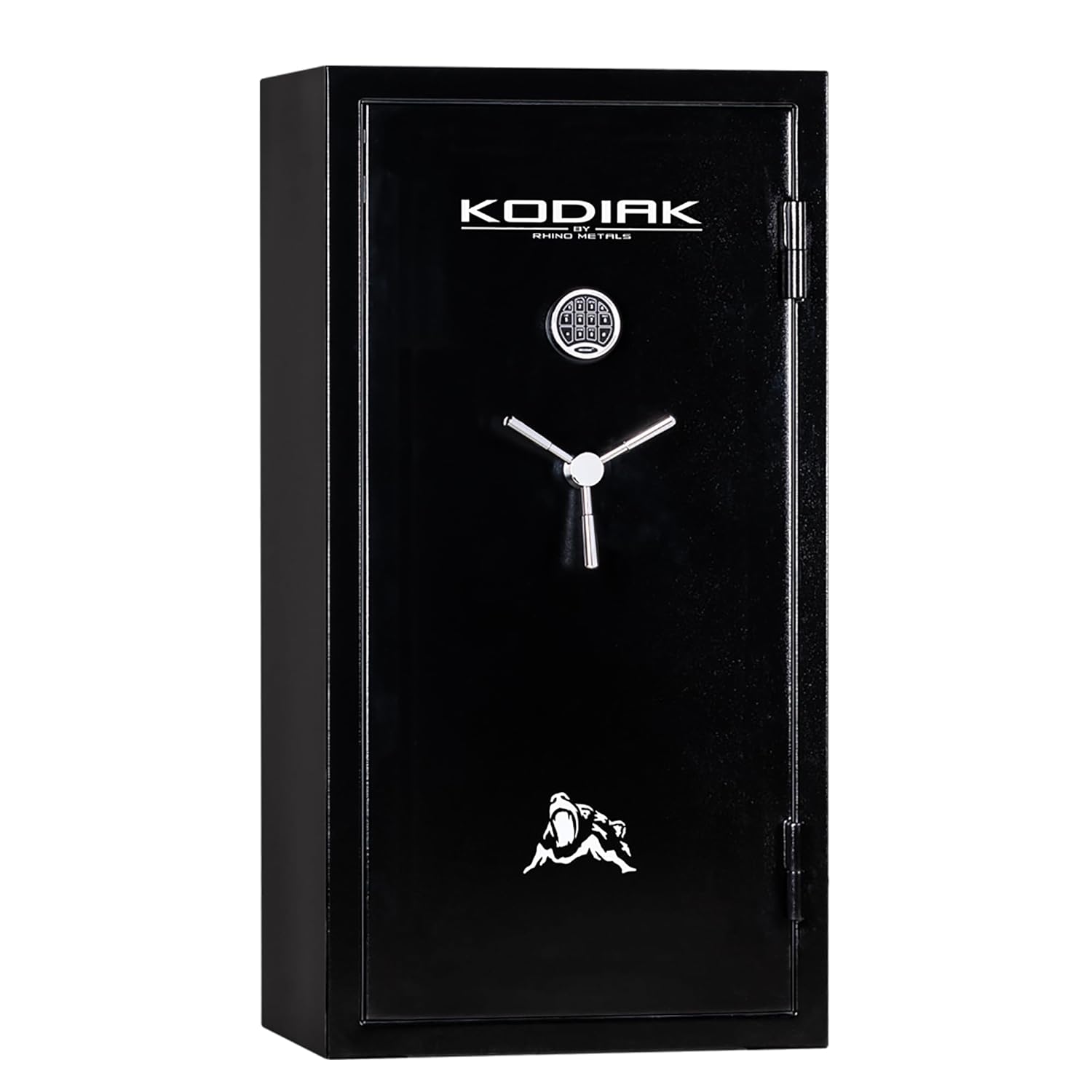
- Kodiak KBX5629. 14 gauge steel, UL listed electronic lock, spring loaded relocker, 30 minutes at 1400 degrees Fahrenheit, 42 long guns and 9 handguns at about 390 pounds. It suits a large collection in a fixed location, and that weight makes installation a two person job at minimum.
- GunVault SV500. A 20 gauge mountable box with an auto drop down drawer, a No-Eyes keypad, anti pry tabs and concealed hinges. It suits bedside or vehicle mounting, though the chamber is 13 by 8.5 by 2.75 inches and it is not water resistant.
- HOLEWOR biometric pistol safe. Alloy steel, up to 100 fingerprints and 10 passcodes, three mounting orientations and a USB-C emergency power port. It suits a household with several authorized users, though the backup key sits behind the door.
- SnapSafe Under Bed Safe XXL. A 14 gauge, 140 pound container at 48 by 24 by 7 inches with a 3 to 8 digit code, backup key and a five foot cable. It suits a room with no space for an upright cabinet, though the 5 inch interior height rules out scoped rifles.
Frequently asked questions
Does a biometric lock replace a keypad?
Rarely. Fingerprint readers can need a second scan when a finger is damp or dirty, which is why most biometric models keep a keypad and a mechanical override. Treat the fingerprint reader as the fast path and the other methods as the fallback.
What does a Residential Security Container rating mean?
It means the container was subjected to a defined attack with common hand tools by technicians working within a set time, under UL 1037, and did not open. It is a repeatable laboratory benchmark rather than a statement about any specific break in attempt.
Where should storage rules be checked?
With your state, county and municipal authorities, and with the safe manufacturer for installation and anchoring. Requirements vary widely by location and change over time, so a published guide is not a substitute for the rules that apply where you live.