
A tool belt works when it carries only the tools you reach for more than a few times an hour, positioned so your dominant hand finds each one without looking. Everything else belongs in a bag or box, because weight on the hips is what turns a useful belt into a back problem.
Key takeaways
- Start from an empty belt and add tools only when you notice yourself walking back for them.
- Put frequently used tools on the dominant side, consumables on the other, and keep the small of your back clear.
- Suspenders or a padded harness move load off the hips and are the usual fix for a belt that hurts.
- Modular pouches beat a fixed apron, because you can rebuild the layout when the job changes.
- Take the belt off before climbing into an awkward position, and never let a tool hang where it can fall on someone.
Start empty and earn every pocket
The common failure is buying a belt with a large pocket count and filling every one. Twenty pounds of hardware on your waist over an eight hour day compresses the lower spine, restricts movement in tight spaces, and snags on everything you pass.
A better method is subtractive. Wear the belt with the four or five tools you use continuously: a tape measure, a driver or two, pliers, a utility knife, a pencil. Work a full day. Anything you walked back to the bag for twice gets promoted, and anything you never touched comes off. Trade shapes the result: framing needs a hammer, square, and nails, while electrical work is mostly small drivers, snips, and a tester, which suits a compact pouch rather than a full apron.
Layout: where each tool goes
Position is what makes a belt fast. Your dominant hand should draw and return a tool blind, and the hands should not cross the body. So put the tools you draw fastest on the dominant side, roughly where your hand falls when it hangs relaxed. That normally means the tape measure clipped forward on the dominant hip, pliers and drivers in the main pouch just behind it, and a knife or snips in a dedicated slot rather than loose. Consumables such as fasteners and tape go on the non dominant side, because you feed them to the working hand rather than drawing them under time pressure.
Keep the small of your back empty. Anything back there digs in when you kneel, lean against a wall, or sit in a vehicle, and it is invisible when it catches on something. Hammer loops belong outboard on the non dominant side so the handle swings clear of your leg. Long shanked drivers want through pockets that let the shank pass all the way down. Keep a consistent home for each tool, because speed comes from muscle memory.
Weight, fit and saving your back
Fit determines whether load sits on bone or on soft tissue. The belt should ride on the iliac crest, the shelf of the hip bones, not around the waist. Too high and it slides down all day, too low and it fouls your thighs when you kneel. A wider padded belt spreads pressure over more area, which is the difference between discomfort and numbness by mid afternoon.
Once a loaded belt passes roughly 15 pounds, suspenders become the sensible answer. They transfer a share of the load to the shoulders and stop the belt dragging your trousers down, so rings or clips for attaching them are a feature worth looking for. The alternative is a two part approach: a light belt for the constant tools and a bag staged nearby for everything else. Storage for that second tier is covered in the comparison of tool bags, boxes and rolling chests.
Modular pouches versus a fixed apron
A fixed apron belt arrives with its pockets sewn in place. It is simple, usually cheaper, and fine if your work does not change much. A modular setup uses a plain belt plus separate pouches and holsters that clip or thread on, so you can strip down to two pouches for a service call and build back up for an installation day. Pouches also wear at different rates, and replacing one beats replacing a belt.
Check the attachment method before buying. A wire formed clip is fast to move but can ride up on a wide belt, while a threaded closed loop is more secure and slower to reposition. Holsters with an open bottom shed debris rather than collecting it. See the tool belts category and the tool pouches category for the formats covered here.
Safety habits worth keeping
A loaded belt changes your balance and your profile. Sheath knives and chisels, and never carry an edge in an open pocket where it can meet your leg or a colleague’s hand. Anything that can fall out when you bend over belongs in a closed pocket, because a dropped tool from height is a serious hazard. Belts also catch on scaffolding and moving machinery, so take the belt off before working around rotating equipment. On ladders keep the load light, keep three points of contact, and hoist heavy items separately, as set out in the ladder safety guide. Follow the manufacturer instructions and any site rules that go further.
Options from this catalog
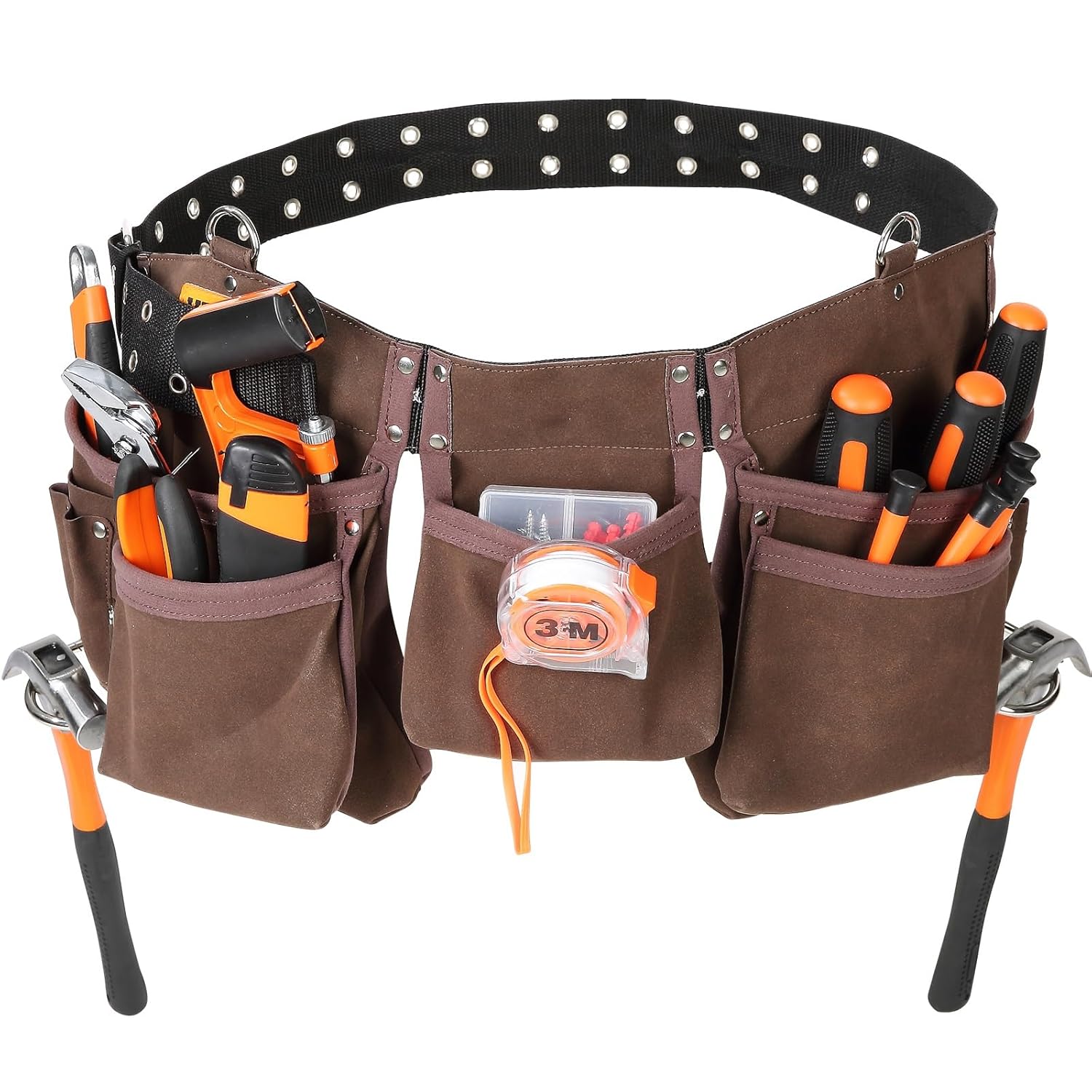
- VEVOR 13 pocket tool belt: a faux suede carpenter style belt adjustable from 29 to 54 inches, with dual hammer loops and suspension rings. Suits someone wanting a full apron out of the box, though the review notes it is bulky, lightly padded, and the buckle can shift.
- Veto Pro Pac MP2X pouch: a leather backed pouch at 6 by 5 by 10.5 inches with 24 pockets, two through pockets, and a stainless tape clip, rated to about 5 pounds. A good core pouch for electrical work.
- Veto Pro Pac SC45 holster: a semi rigid neoprene pouch at 5.5 by 4.5 by 8.5 inches, with a removable six pocket front section, padded phone pocket, magnetic flap, and double gated carabiner. Suits a phone plus a small tool set without a full apron.
- Custom Leathercraft 417 plier holder: a leather holder around 3.75 by 1 by 9.63 inches at roughly 0.15 pounds, with a molded open bottom that sheds debris. A single purpose add on, but with no closure strap smaller tools can slip out.
For a smaller carry, the Veto MP1X covers similar ground at 5 by 4.5 by 10 inches and about 0.9 pounds. A pocket light usually earns its place too, and the everyday carry flashlight guide covers that choice.
Frequently asked questions
How much weight is too much on a belt?
No universal figure, but comfort drops off sharply past about 15 pounds without suspenders. If your lower back aches before lunch, the belt is too heavy or sitting in the wrong place.
Leather or synthetic?
Leather resists abrasion and holds its shape, which suits framing and heavy tools. Synthetic is lighter, dries faster, and offers more pocket variety. Many pouches combine both, using leather where wear is worst.
Should the tape measure go on the belt or in a pocket?
Either works, but a dedicated clip on the dominant hip is faster and less likely to drop the tape when you kneel. Many pouches include a stainless clip for this.
Is a bag still needed alongside a belt?
Usually yes. The belt carries what you use constantly, and the bag carries meters, spares, and specialist tools. Splitting the kit this way is what keeps belt weight sensible.