
A heat gun is a controlled hot air source used for shrinking tubing, softening paint and adhesives, bending plastic, thawing pipes, and loosening seized fasteners. The job is chosen by temperature band: heat shrink tubing recovers between roughly 90 and 135 degrees Celsius, while paint softening needs 200 to 400 degrees Celsius, and running the wrong band either does nothing or scorches the work.
Key takeaways
- Heat shrink tubing is a low temperature job. Most 2 to 1 polyolefin starts moving near 90 degrees Celsius and fully recovers around 120 to 135.
- Paint stripping sits far higher, commonly 200 to 400 degrees Celsius, and the paint should bubble rather than smoke.
- Keep the gun moving. Dwelling in one spot is what burns wood, melts vinyl, and scorches paint into the surface.
- A heat gun is a genuine fire and burn risk, and nozzles stay dangerously hot for minutes after switch off.
- Never heat paint that may contain lead without following the lead safe rules that apply where you live.
How a heat gun differs from a torch and a hair dryer
All three move air, but the comparison ends there. A hair dryer tops out near 60 degrees Celsius, which will not shrink tubing properly and will not soften anything. A torch produces an open flame with a very small hot zone, which is what you want for plumbing solder and brazing and exactly what you do not want near plastic, paint, or a wiring loom.
A heat gun sits between them: a broad, flameless heat field with an adjustable or switched temperature and an airflow rate quoted in cubic feet per minute. Flameless matters because heat spreads across an area rather than a point, and airflow matters because it sets how quickly that heat transfers, which is why two guns quoting the same maximum temperature behave differently. If the job is soldering copper pipe rather than shrinking tubing, the torches category is the relevant tool group.
Temperature bands by task
Manufacturers vary, so treat these as working ranges and check the specification for your material.
- Heat shrink tubing, roughly 90 to 135 degrees Celsius. Standard 2 to 1 polyolefin begins recovering near 90 and finishes around 120 to 135. Adhesive lined tubing needs the upper end so the glue flows.
- Bending and forming plastics, roughly 100 to 160 degrees Celsius. Acrylic and PVC soften here. Heat evenly along the bend line, and expect discolouration if you go hotter.
- Adhesives, decals and vinyl, roughly 90 to 200 degrees Celsius. Enough to soften glue without cooking the substrate. Start low, since trim scorches easily.
- Thawing frozen pipes, low setting with constant movement. Warm a long stretch rather than one spot, keep plastic pipe off the upper bands, and never use an open flame.
- Softening old caulk and putty, roughly 200 to 300 degrees Celsius. Hot enough to release the bond, low enough that adjacent glazing survives.
- Paint stripping, roughly 200 to 400 degrees Celsius. The target is bubbling, not smoking. Follow immediately with a scraper while the film is soft.
- Loosening seized fasteners, upper bands. Heat expands the surrounding metal and breaks down thread lock. Keep it off seals, wiring, and fuel lines.
Nozzles change the outcome as much as the dial does. A hook nozzle wraps heat around a pipe or wire, a fishtail nozzle spreads it for stripping, and a reducer concentrates it on one joint. The right nozzle usually lets you work cooler, which is safer for everything nearby.
Corded or cordless
Corded guns generally offer higher sustained output, finer adjustment, and no runtime limit, which suits stripping a door or a long bench session. Cordless guns trade peak capability for reach, and they are transformative for shrinking connectors under a dashboard or thawing a pipe two rooms from an outlet.
Runtime is the number to scrutinise, because heat guns draw heavily and quoted figures assume intermittent use. A few dozen shrink connections per charge suits cordless, while an afternoon of paint removal wants a cord. Two more features earn their keep: a cool down setting that runs the fan without the element so the barrel is safe to stow sooner, and a lock on or lock off trigger.
Safety that actually matters
Heat guns start fires. The air leaving the nozzle is well above the ignition point of paper, sawdust, and solvent vapour, and heat driven into a wall cavity can smoulder unseen for hours. Keep a clear area, never point the gun into a void, and check the area again before leaving.
Burns are the other common injury, and most happen after switch off, because the nozzle stays hot for several minutes. Set the gun on its stand or a heat resistant surface, never on carpet, and let the cool cycle finish. Wear heat resistant gloves and eye protection, and keep the exhaust away from your other hand.
Fumes need ventilation, since heated paint, plastics, and adhesives release irritants. Paint applied before the late 1970s may contain lead, and heating it can create lead fume, so follow the lead safe renovation rules that apply in your jurisdiction rather than guessing. Follow the manual for your specific gun, because temperature settings, nozzle fitting, and cool down procedure vary between models.
Options from this catalog
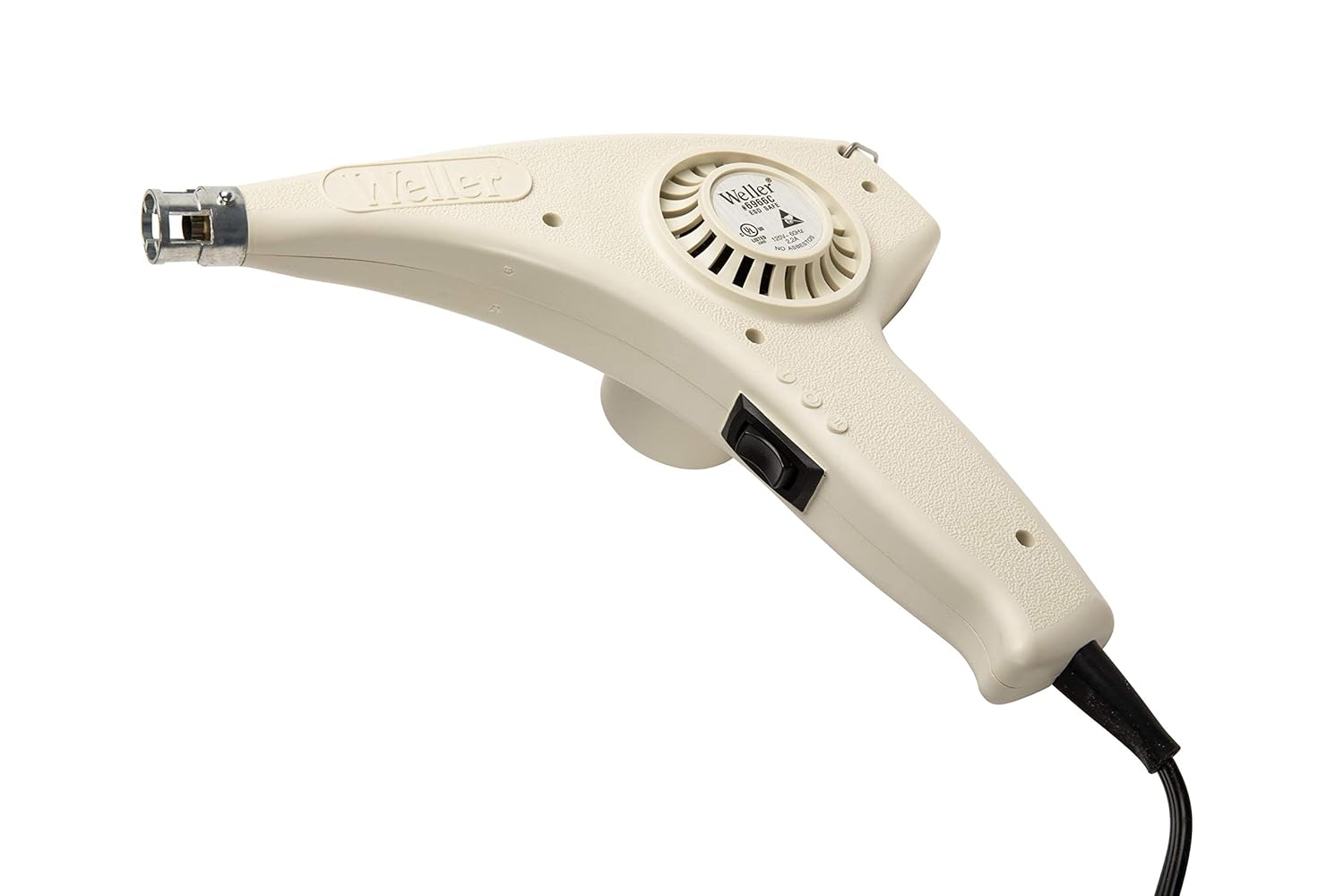
- Weller 6966C industrial heat gun: a 250 watt corded unit under a pound, with a three way Hi, Off and Cool switch and a 6 foot grounded cord, running 750 to 800 degrees Fahrenheit. Suits bench electronics work, though the range is fixed, no nozzles are supplied, and there is no stand.
- DEWALT DCE530B cordless heat gun: a 20V MAX tool quoted up to 990 degrees Fahrenheit, with two temperature settings, 6.7 CFM airflow, an LED, lock on and lock off, and flat plus hook nozzles at 1.65 pounds. Suits work away from outlets, though it is a bare tool and the 42 minute runtime assumes intermittent use.
- Milwaukee 2688-20 cordless heat gun: a compact M18 unit at 6.4 inches and about 1.7 pounds, reaching working temperature in around seven seconds, with a guarded nozzle, an LED, and Redlink temperature management. Good for shrink tubing in tight spaces, though the guard limits access to very narrow spots and batteries are not included.
- Milwaukee 2267-20 infrared thermometer: not a heat gun but the tool that tells you what the surface actually reached, with a 10 to 1 distance to spot ratio, an LCD display, and roughly 12 hours of runtime from a 9V battery at about 0.81 pounds.
The full heat guns category lists what is covered here.
Frequently asked questions
Can a hair dryer shrink heat shrink tubing?
Rarely, and not properly. Most hair dryers cannot exceed about 60 degrees Celsius, well short of the 90 or more that standard tubing needs, so the result is a partial shrink that does not seal.
Can a heat gun replace a soldering iron?
No. A heat gun heats a broad area with air, which is useful for board rework but cannot deliver controlled heat to a single joint. That is a different tool, covered in the comparison of stations and irons.
Why did the paint scorch instead of bubbling?
Usually too hot, too close, or held in one place. Back the nozzle off, drop a band, and keep the gun sweeping so the film lifts before the surface underneath takes damage.
How can you confirm the surface reached the right temperature?
Measure it. An infrared thermometer reads the surface directly rather than the air leaving the nozzle. The same principle applies at the bench, where the soldering temperature guide explains why a displayed setpoint and the actual work temperature differ.