
An IP rating is a two digit code from the international standard IEC 60529, where the first digit describes protection against solids such as dust and the second describes protection against water. On flashlights the numbers you meet most often are IPX4, which covers splashing from any direction, IPX7, which covers immersion to 1 metre for 30 minutes, and IP68, which means dust tight plus immersion deeper than 1 metre to a depth the manufacturer has to state.
Key takeaways
- IP stands for Ingress Protection. First digit is solids, second is water.
- An X means that digit was not tested, not that the protection is zero. IPX8 tells you nothing about dust.
- IPX4 is splashing, IPX5 is low pressure jets, IPX6 is powerful jets, IPX7 is 1 metre for 30 minutes, IPX8 is deeper immersion at the manufacturer’s stated depth and duration.
- The 6 in IP67 and IP68 means dust tight, which matters as much as water on a building site.
- Ratings are established on a new, correctly assembled light. O rings, threads and charging port covers are what keep the rating true in service.
How to read the code
Read IP67 as two separate results. The 6 is the solids test, the 7 is the water test. They are graded independently, so a light can be excellent at one and untested at the other.
The solids scale runs 0 to 6. For flashlights only the top two matter: 5 means dust protected, where limited dust may enter but not enough to interfere, and 6 means dust tight.
The water scale is the one that gets misread.
- IPX4. Splashing water from any direction. Rain and a wet worktop, not a puddle.
- IPX5. Low pressure water jets from any direction.
- IPX6. Powerful water jets. Suitable for hosing down, still not immersion.
- IPX7. Immersion in 1 metre of water for 30 minutes.
- IPX8. Continuous immersion deeper than 1 metre, under conditions the manufacturer specifies. IPX8 on its own is not a depth.
Note that IPX7 and IPX6 test different things. A light rated IPX7 has not necessarily passed the jet test, which is why some products are marked with both.
What each level means in practice
The handheld flashlights category spans nearly the whole range, which makes the differences easy to see.
At the splash end, the Klarus E5 and the Streamlight 66320 MacroStream are both rated IPX4. They will shrug off rain on a walk home. Dropping either into a bucket is not covered.
A step up, the RovyVon A3 is IPX6 and the Fenix E06R is IP66, so both are rated against powerful jets and the Fenix adds a dust tight body.
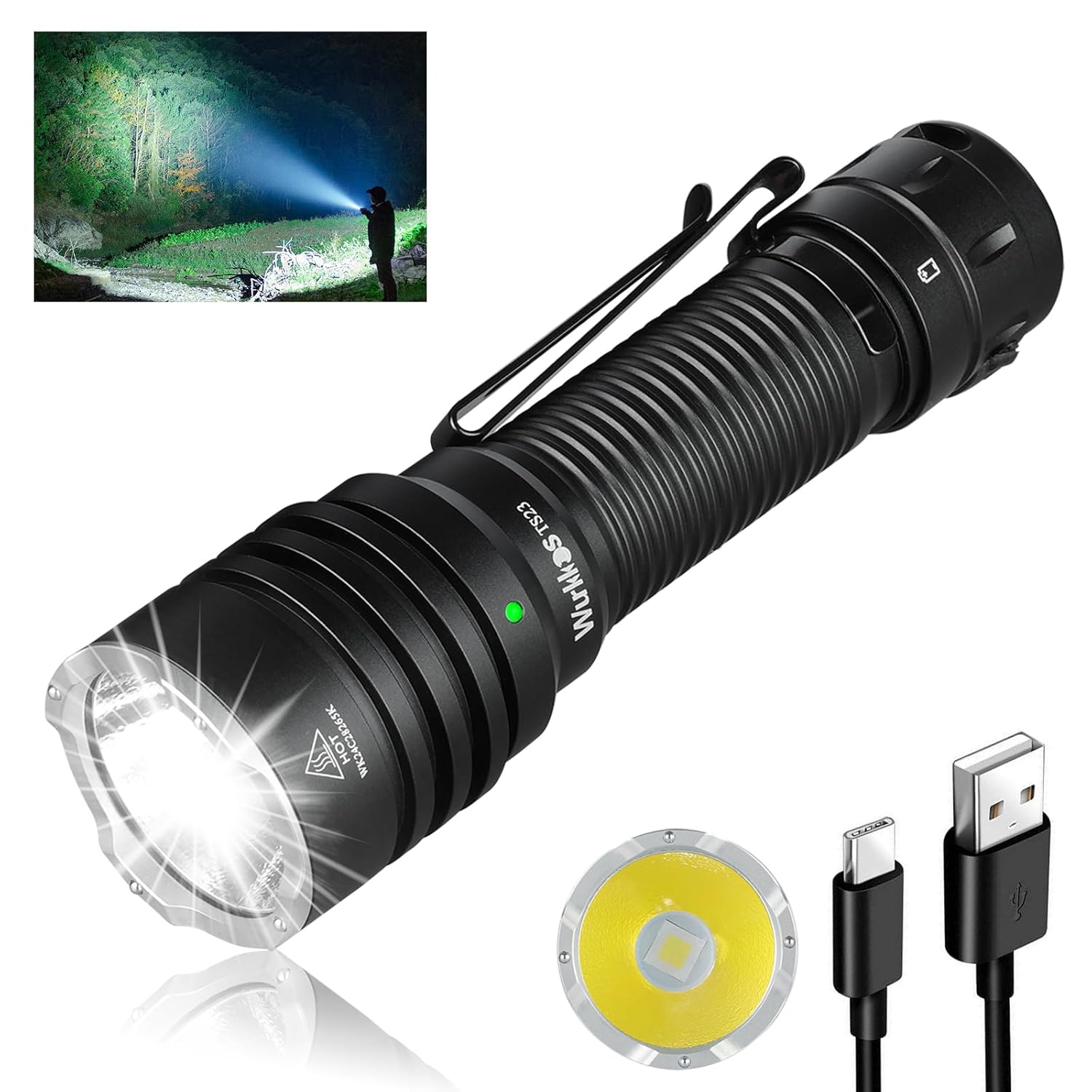
At the immersion end, the Milwaukee 2011R carries IP67, while the Wurkkos TS23, the Wurkkos TS26S and the Nitecore EDC35 are all rated IP68. The LUMINTOP GT Nano is marked IPX8, which covers immersion but says nothing about dust.
IP68 is not one single number
This is the most common misunderstanding. Because IPX8 is defined as conditions agreed by the manufacturer, two IP68 lights can be rated for very different things. One might be tested at 2 metres for 30 minutes, another at 10 metres.
The Wurkkos TS23 is a useful example because the figure is stated: submersion to 2 metres for 30 minutes, backed by two O rings in the box. When a listing says IP68 with no depth or duration attached, the rating is doing less work than it appears to.
Impact ratings are a separate thing
Drop resistance is not part of IP at all. It is normally quoted separately in metres, following the ANSI FL1 flashlight standard, and it tells you the height the light survived in testing while remaining functional.
The spread is wide. The Streamlight MacroStream is rated to 1 metre, the LUMINTOP GT Nano to 1.5 metres, the Nitecore EDC35 to 2 metres, and the Milwaukee 2011R to 4 metres. For anyone working above ground level or on concrete, that second figure is often more relevant than the water rating.
What actually breaks the seal
A rating describes the light as it left the factory. In service, seals fail for predictable reasons.
- An open charging port. A rubber flap that is not pushed fully home leaves the contacts exposed. This is the single most common cause of water getting inside a modern rechargeable light.
- Tired O rings. They flatten, dry out and pick up grit. Several manufacturers supply spares for exactly this reason, and replacing them is part of normal maintenance.
- Dirty or cross threaded tailcaps. Sand and dust in the threads stop the O ring seating. Clean the threads before reassembling, and follow the manufacturer’s guidance on lubricant.
- Opening the light in the wet. Changing a cell in the rain puts water inside the tube where no rating helps.
- Salt water. No IP rating implies corrosion resistance. Rinse with fresh water and dry the light after any exposure to salt.
If a light has been submerged and you suspect water got in, follow the manufacturer’s instructions for that model rather than improvising. With any lithium cell, a light that has taken water inside should be treated as a fault to be checked, not something to keep using and hope.
Three lights for genuinely wet work
- Wurkkos TS23: IP68 with a stated 2 metres for 30 minutes, 5000 lumens, a 482 metre beam and spare O rings supplied. Suits outdoor and marine adjacent use where the light will get soaked rather than splashed.
- Milwaukee 2011R: IP67 plus a 4 metre impact rating, 500 lumens, up to 75 hours on low and a magnetic base. Suits site work where drops are more likely than immersion.
- Nitecore EDC35: IP68 with a waterproof charging port and a 2 metre impact rating, 5000 lumens. Suits people who want high output that can stay out in weather.
- Wurkkos TS26S: IP68 with 3100 lumens, a 95 CRI emitter and a magnetic tail cap. Suits inspection work outdoors where colour accuracy is worth having.
FAQ
Is IPX7 better than IPX6?
They test different exposures. IPX7 covers 30 minutes at 1 metre of immersion, IPX6 covers powerful jets. A light that passes one has not automatically passed the other, so products intended for both are usually marked with both.
Can I take an IP68 flashlight diving?
Only to the depth and duration the manufacturer states, and only if the light is sold for that purpose. Dive lights are specified differently, with pressure rated seals and switches. Check the manufacturer’s documentation before taking any light below its stated depth.
Does a waterproof rating cover the charging port?
Only with the cover closed. Some lights, such as the Nitecore EDC35, advertise a waterproof charging port, but the rating still assumes the light is sealed as designed.
What rating do I actually need?
IPX4 is enough for a light that lives indoors and in a car. IP67 or IP68 is worth paying for on anything used outdoors, on site or around water. The broader buying process is in how to choose a flashlight, output figures are covered in lumens explained, and pocket carry in the EDC flashlight guide.