
A digital multimeter measures voltage, resistance and current, and safe use comes down to matching the meter, the leads and the dial setting to the circuit in front of you. The harder truth is that most multimeter incidents are caused by the circuit rather than the instrument, so work on live mains wiring belongs with a qualified electrician rather than a first time user.
Key takeaways
- The CAT category and voltage number printed on a meter describe the circuits it is built to survive, not just the values it can display.
- Test leads carry their own rating. A weak lead on a strong meter drags the whole assembly down to the weaker figure.
- Current measurement is the highest risk mode, because it places the meter in the current path. Fuses and jack selection matter here more than anywhere else.
- Resistance and continuity readings are only meaningful on a circuit that has been isolated and proven dead by someone qualified to do that.
- Meters differ in their controls, warnings and limits, so the manufacturer manual for your specific model is the authority rather than any generic article.
What a multimeter actually measures
Three functions define the tool. Voltage is measured across two points, with the meter in parallel with whatever is being checked. Resistance is measured on a de-energised component, with the meter supplying its own small test current. Current is measured in series, meaning the circuit has to be opened and the meter inserted into the path.
Modern handhelds add more. The Klein Tools MM420 covers voltage, current, resistance, continuity, temperature, capacitance, frequency, duty cycle and diode testing on one dial, and the Fluke 17B Plus lists a temperature range of minus 55C to 400C. Those extras do not change the safety picture. The dial position determines what the meter expects to see, and a meter set to resistance or current then touched to a live conductor is the classic route to a damaged instrument or worse.
Read the safety rating before the feature list
Every meter built to the IEC 61010 standard carries a measurement category and a voltage. CAT II covers appliances and outlets on a branch circuit, CAT III covers distribution wiring and panels, and CAT IV covers the utility supply side. The category describes how much transient energy the meter can absorb without failing dangerously, which is why a higher voltage on a lower category is not an upgrade.
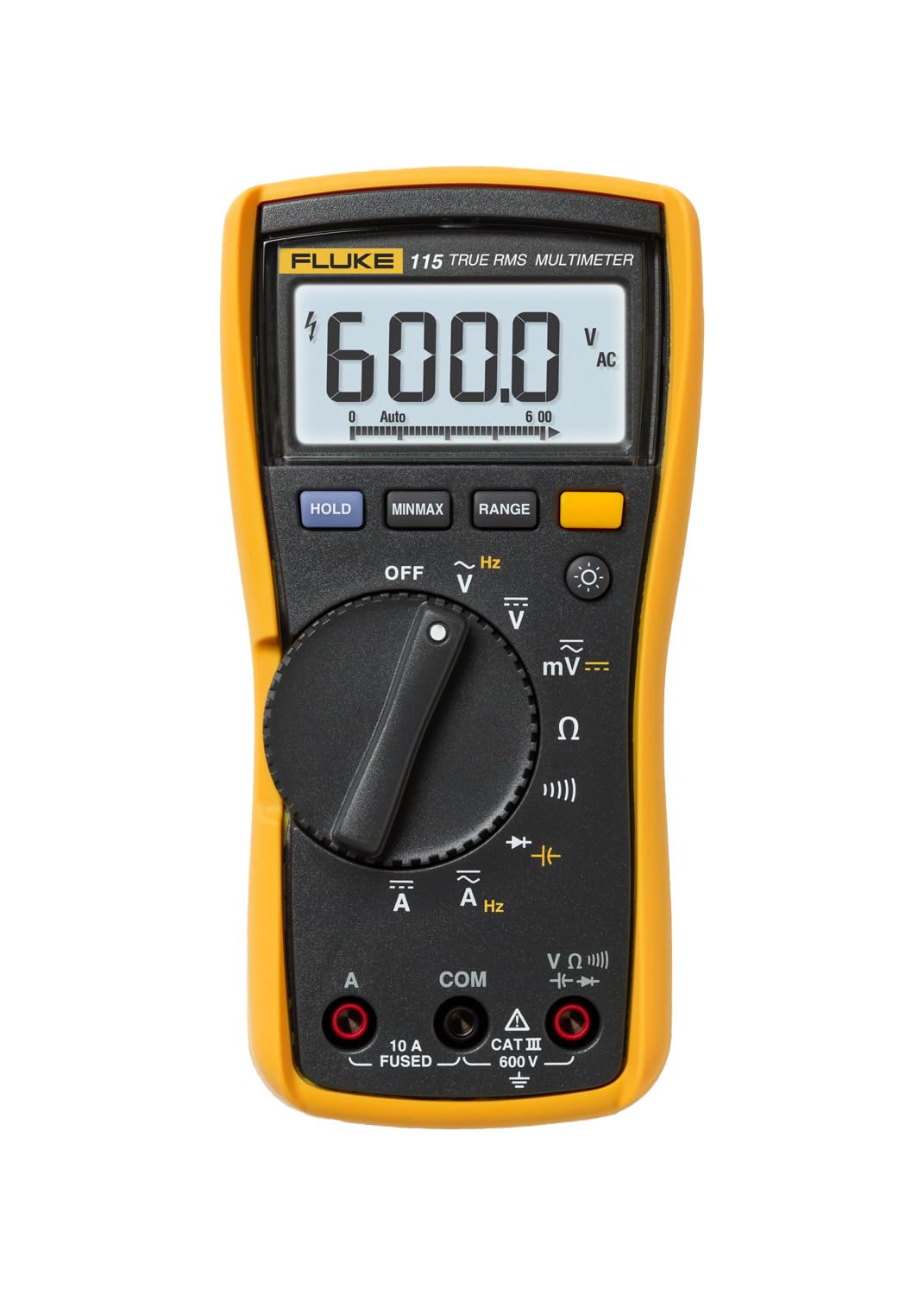
The catalog shows the spread. The Fluke 115 carries CAT III 600V, the Fluke 177 is listed at CAT IV 600V and CAT III 1000V, and the Extech EX330 is UL listed at CAT III 600V. Matching that number to the work is the most important decision a buyer makes, and it is covered in the guide to multimeter CAT safety ratings.
Leads, jacks and fuses are part of the safety system
A meter is only as protected as the weakest item connected to it. Cracked insulation, overlong probe tips and unrated replacement leads all undermine the rating stamped on the case. Lead sets such as the AstroAI test lead kit state compliance with IEC and EN 61010, and that marking is worth checking before anything is plugged in.
Jack selection causes a large share of real world mistakes. Leaving a lead in the current jack and then switching to voltage creates a very low resistance path across the source, which is what the fuses in a rated meter exist to interrupt. Some designs head this off in hardware: the Klein MM420 lights the jacks under its Lead Alert Protection feature, and the KAIWEETS HT118A lights the correct ports for the selected function.
Current is the mode that deserves the most caution
Because current measurement requires breaking the circuit, it involves more handling of live conductors than any other function and exposes the meter to fault energy directly. Ranges are tightly limited too. The Fluke 115 supports its 20A range for 30 seconds at a time, and the Fluke 17B Plus tops out at 10A. Exceeding those limits means a blown fuse at best.
This is why clamp measurement exists. A clamp reads current from the magnetic field around a conductor without opening the circuit. The Fluke i410 clamp attaches to a meter with safety shrouded banana plugs and reads AC and DC current up to 400A on conductors that fit its 30mm jaw, and the clamp meter guide covers the trade offs.
Readings that mislead
Two effects trip up newer users. Ghost voltage appears when a high impedance meter picks up a capacitively coupled reading on a conductor with no real source behind it, which is why some meters offer a low impedance mode to load the circuit and drop those phantom readings away. The Klein Tools CL800 includes a LoZ mode for this, and a low reading is still never proof that a circuit is safe to touch. The second effect is waveform shape, since average responding meters assume a sine wave and misread the chopped output of drives, dimmers and switching supplies. That is covered in true RMS explained.
Meters in this catalog and who they suit
- Fluke 115. A compact True RMS meter rated CAT III 600V with a backlit 6000 count display. Suits field service technicians who want a rugged general purpose meter and can accept its weight and the lack of a stand.
- Klein Tools MM420. Auto ranging True RMS to 600V with temperature, capacitance and duty cycle. Suits electricians who want one dial covering HVAC and general troubleshooting, though it is bulkier than pocket meters.
- Extech EX330. A small CAT III 600V auto ranging meter with a built in non contact detector and a Type K probe. Suits homeowners and hobbyists, with leads and small buttons as its weak points.
- Innova 3320. Auto ranging with colour coded battery status LEDs and 10 MegOhm input impedance for automotive circuits. Suits car and household diagnostics, and it has no backlight.
The full range sits under multi testers, with simpler go or no go tools listed under voltage testers.
Where to stop and call an electrician
Opening a panel, working inside a service entrance, testing above the meter category, or troubleshooting a circuit that cannot be isolated are jobs for a licensed electrician. The same applies wherever wiring is unfamiliar, damaged or showing heat marks. Owning a capable meter does not confer the training to work safely on energised equipment, and that gap is where people get hurt.
FAQ
Can a multimeter prove a circuit is dead?
Only as part of a procedure carried out by a qualified person, which includes proving the meter on a known live source before and after the test. A single low reading is not proof of anything, and a non contact tester never proves a circuit is dead.
Do the fuses inside a meter really matter?
Yes. The high energy fuses in a rated meter are sized to interrupt a fault before it becomes an arc, and generic replacements defeat the protection the meter was certified with.
Is a multimeter the right tool for finding a breaker?
No. Tracing an outlet back to its breaker is a job for a dedicated transmitter and receiver pair, covered in how to find which breaker controls an outlet.