
HEPA, H13 and MERV are three rating systems describing the same physical property: what fraction of particles of a given size a filter media captures in a single pass. HEPA is a performance definition, H13 is a class within the European EN 1822 standard, and MERV is the ASHRAE scale used for heating and ventilation filters, so a number from one scale cannot be read directly against a number from another.
This guide explains what each label certifies, why 0.3 microns is the reference size, and what the phrase True HEPA does and does not mean. These are filtration components, so everything below describes capture efficiency by particle size and nothing else.
Key takeaways
- The United States Department of Energy definition of HEPA is 99.97 percent capture of particles at 0.3 microns.
- Under EN 1822, H13 is rated at 99.95 percent and H14 at 99.995 percent, both measured at the most penetrating particle size.
- 0.3 microns is the hardest size to capture, not the smallest. Filters capture both larger and smaller particles at higher efficiency.
- MERV runs from 1 to 16 under ASHRAE 52.2 and is scored across three particle size bands.
- True HEPA is a marketing phrase with no governing body behind it. The useful figure is the stated efficiency at a stated particle size.
What HEPA certifies
High efficiency particulate air filtration is defined in the United States by the Department of Energy as media removing at least 99.97 percent of particles at 0.3 microns in diameter. That single figure is the whole definition, and it says nothing about airflow, filter life or odor handling.
The media works through several mechanisms at once. Large particles are caught by interception and impaction as air weaves through the fiber matrix. Very small particles move erratically through Brownian motion and collide with fibers rather than following the airstream. Between those two regimes sits a size neither mechanism handles well, and for most HEPA media it falls near 0.3 microns, which is why the standard tests there.
So a filter rated 99.97 percent at 0.3 microns is capturing particles at 0.1 microns and at 1 micron more efficiently than that headline number, not less. This is the single most misread point in the whole category.
H13 and H14 under EN 1822
EN 1822 is the European standard, and it splits filters into groups. E10 to E12 are efficient particulate air classes, H13 and H14 are the HEPA classes, and U15 to U17 are ultra low penetration classes. H13 requires 99.95 percent overall efficiency at the most penetrating particle size, and H14 requires 99.995 percent.
Consumer purifier makers frequently quote their own figures alongside the class, such as 99.9 percent at 0.1 microns. Those are manufacturer stated results at a size of their choosing rather than the EN 1822 test point, so when two products quote different particle sizes the numbers are not comparable.
Check also whether the class applies to the filter or the whole appliance. A unit with an H13 filter and a bypass path around it delivers less than the media rating suggests, which is why filter makers emphasize a snug seat with no air bypass.
Where MERV fits
MERV, the minimum efficiency reporting value, comes from ASHRAE standard 52.2 and runs from 1 to 16. Unlike HEPA it is scored across three particle size bands: 0.3 to 1.0, 1.0 to 3.0 and 3.0 to 10.0 microns. The published number is the worst result across the required bands, which is why it is called a minimum.
In broad terms, MERV 8 handles the coarse band and does little in the finest. MERV 11 is rated in the region of 65 to 79 percent for the 1.0 to 3.0 micron band. MERV 13 adds a requirement in the 0.3 to 1.0 micron band, and MERV 14 raises it further. HEPA media sits above MERV 16, though the two systems are not formally aligned.
MERV matters most in ducted systems, because denser media restricts airflow more. A blower sized for MERV 8 may not move design airflow through MERV 13 media in a one inch slot, which is why deeper four inch cabinets exist and why depth is what lets a high rating and acceptable pressure drop coexist.
Pre filters and carbon layers
Most replacement cartridges are stacks rather than single sheets. A pre filter catches hair and coarse dust so the fine media does not load prematurely, the HEPA layer does the particulate work, and an activated carbon layer adsorbs gases and odors. Carbon works by adsorption rather than by particle size, so it carries no HEPA or MERV number at all.
Carbon also saturates on its own schedule, usually faster than the particulate media loads, so a stacked cartridge often gets replaced when the carbon is spent rather than when the HEPA layer is full. Bench fume extraction splits the same way, a point touched on in the notes about soldering flux.
How these ratings appear in the catalog
Four cartridges from the air purifier filters category, chosen because each one labels a different rating system.
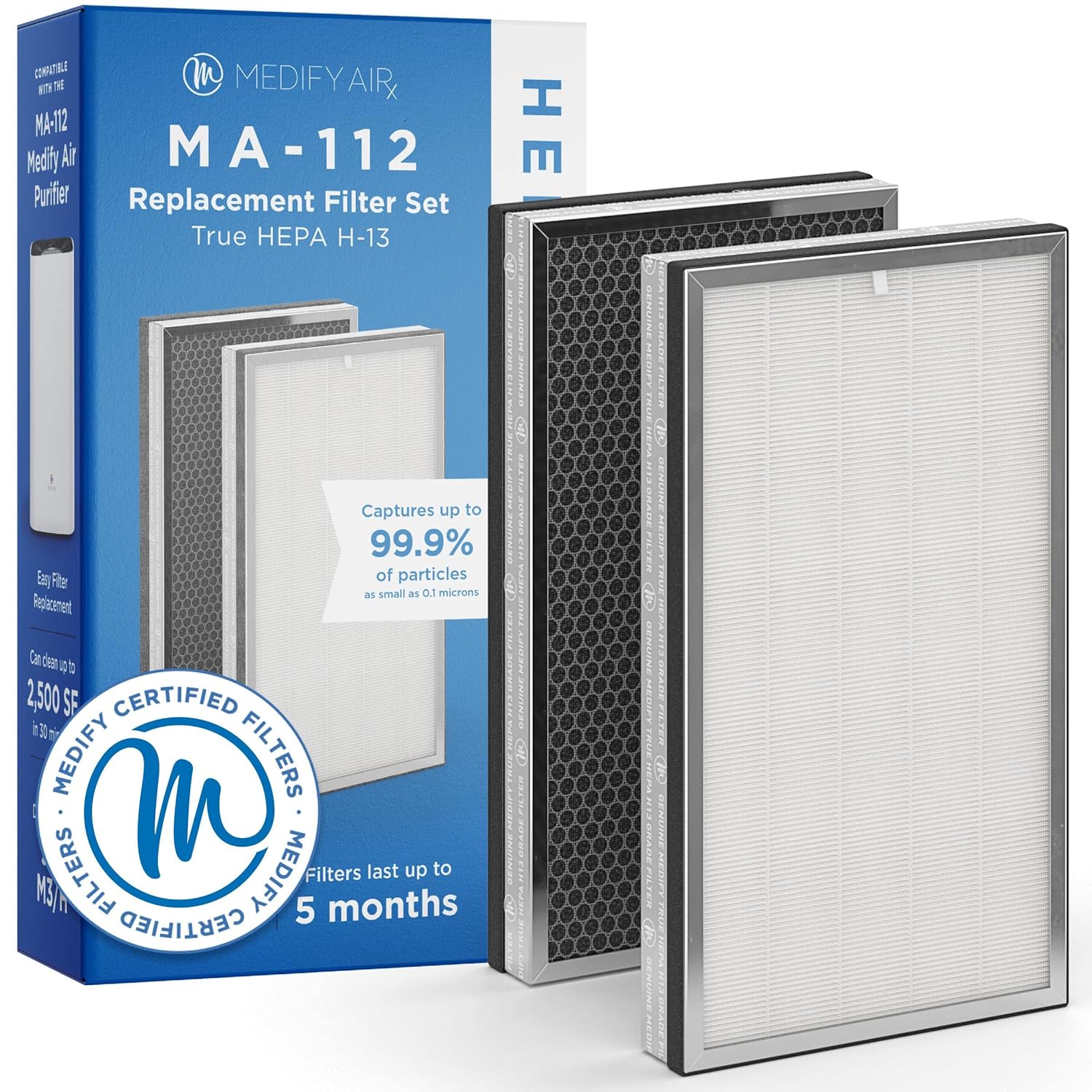
- Medify Air MA-112 replacement filter. Pre filter, H13 HEPA and activated carbon, stated by the manufacturer at 99.9 percent of particles as small as 0.1 microns and also described as MERV 14. It suits an MA-112 owner who wants both figures on one part, in a large 50 by 36 by 3 inch cartridge.
- Medify Air MA-40 replacement filter. The same three stage layout at H14, one class above H13, stated at 99.99 percent down to 0.1 microns in a 17.5 by 8.5 by 2 inch cartridge. It suits an MA-40 owner who wants the higher class.
- AprilAire 113. A MERV 13 whole house media filter with over 22 square feet of pleated media at four inch depth, UL Classified, rated up to 12 months. It suits a ducted AprilAire cabinet rather than a portable unit, so confirm compatibility by model number.
- AprilAire 310. The MERV 11 equivalent at a nominal 20 by 20 by 4 inches, trading fine band capture for lower resistance. It suits a system where blower capacity or duct static pressure makes MERV 13 media a poor fit.
Replacement intervals are a separate subject, covered in the guide to when to replace an air purifier filter. For diagnosing airflow across a ducted system, surface temperature mapping is described in the thermal imager guide.
Frequently asked questions
Is H13 better than True HEPA?
They are close and they are measured differently. The Department of Energy HEPA definition is 99.97 percent at 0.3 microns, while EN 1822 H13 is 99.95 percent at the most penetrating particle size. True HEPA has no governing body, so compare the stated efficiency and the stated particle size instead of the phrase.
Can a MERV rating be converted to a HEPA rating?
Not precisely. MERV is a banded scale from ASHRAE 52.2 and HEPA is a single point efficiency figure, so any comparison is approximate. HEPA media sits above the top of the MERV scale, which ends at 16.
Does a higher MERV number always make sense?
No. Denser media raises pressure drop, and a ducted system has a static pressure budget. Check what the equipment manufacturer permits before stepping up a grade.