
True RMS is a measurement method that reports the heating equivalent value of an AC waveform whatever shape that waveform happens to be. It matters because cheaper average responding meters assume a clean sine wave, and on the distorted waveforms produced by drives, dimmers and switching power supplies they can be significantly wrong.
Key takeaways
- RMS stands for root mean square, the value of AC that delivers the same heating effect as an equivalent DC value.
- Average responding meters measure the rectified average and multiply by a fixed factor that is only correct for a pure sine wave.
- On non sinusoidal loads the error runs in either direction and can be large enough to change a diagnosis.
- Crest factor sets the practical limit of a True RMS meter, so heavily peaked waveforms can still exceed what the instrument handles accurately.
- For DC, resistive loads and clean utility sine waves, an average responding meter reads correctly and True RMS changes nothing.
What RMS actually describes
An AC voltage swings above and below zero, so its arithmetic average over a cycle is zero and tells you nothing. RMS solves that by squaring the instantaneous values, taking the mean, then taking the square root. The result is the DC value that would dissipate the same power in a resistor, which is why a 120V RMS supply heats an element as a 120V battery would.
That definition holds for any waveform. The complication is how a handheld instrument implements it.
How average responding meters cut the corner
Doing the squaring and averaging in hardware costs money, so many meters rectify the input, measure the average, and multiply by a fixed factor of roughly 1.11. That factor is the exact ratio between RMS and rectified average for a pure sine wave, so on utility power feeding a resistive load the answer comes out right.
Feed the same meter a waveform that is not a sine and the assumption collapses. A dimmer chops away part of each half cycle, a variable speed drive output is a train of pulses, and a switch mode supply draws current in short spikes near the voltage peak. In each case the ratio between average and RMS is no longer 1.11, and the displayed number drifts away from reality.
Where the error actually shows up
The distortion sources that matter on a modern job site are easy to list: variable frequency drives, LED drivers and electronic ballasts, phase controlled dimmers, computer and server power supplies, inverters, UPS output and solar equipment.
The consequence is practical rather than academic. A current reading on the load side of a drive with an average responding meter can suggest a motor is running inside its nameplate figure when it is not, or flag an overload that does not exist. Neutral currents in circuits feeding many electronic loads are another classic case.
Product documentation reflects this directly. The Fluke 115 lists True RMS voltage and current measurement specifically for complex non linear loads such as variable speed drives, and the Fluke 177 describes accurate readings of distorted waveforms as the difference against cheaper average sensing meters.
Crest factor, the limit that is easy to miss
Crest factor is the ratio of the peak value of a waveform to its RMS value. A sine wave sits at about 1.41, while a narrow current pulse drawn by a switch mode supply can reach three or more. Every True RMS meter has a specified crest factor limit, and beyond it the instrument clips the peaks and under reads.
Bandwidth is the second limit. A meter that only responds accurately up to a few hundred hertz will not capture higher order harmonics faithfully. The Fluke T5-1000 electrical tester is listed with a 66 Hz measurement bandwidth, which is fine for fundamental mains work and not intended for harmonic analysis. Both figures live in the manufacturer specification for the specific model.
When True RMS changes nothing
It is worth being honest about the cases where the feature is irrelevant. DC measurements do not involve RMS at all, and resistance, continuity and diode tests are unaffected. Clean utility sine waves feeding resistive loads such as heaters and incandescent lamps read the same on either design.
That is why not every instrument carries it. The Innova 3320 is built around auto ranging and colour coded battery status LEDs for automotive and household checks, and True RMS is not among its listed functions. For the work that meter targets, that is a reasonable trade.
True RMS instruments in this catalog
- Fluke 115. True RMS voltage and current, CAT III 600V, 6000 count backlit display, with the 20A range supported for 30 seconds only. Suits field service work on drives and electronic loads where the meter is carried daily.
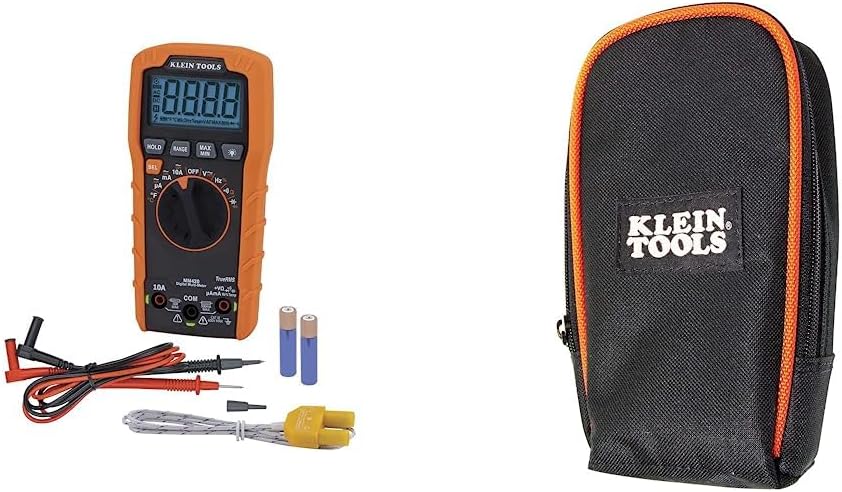
- Klein Tools MM420. Auto ranging True RMS to 600V with temperature, capacitance, frequency and duty cycle. Suits electricians who want distortion tolerant AC readings plus HVAC functions on one dial, accepting a bulkier body.
- Klein Tools CL800 clamp meter. Auto ranging True RMS for AC and DC with a LoZ mode that suppresses ghost voltage, plus IP40 protection and a 6.6 foot drop rating. Suits panel work where stray voltage muddies readings, though it is bulky in tight enclosures.
- IDEAL 61-747 TightSight. True RMS AC and DC clamp to 400A at 600V with a bottom mounted display and a built in flashlight. Suits technicians reading meters at awkward angles near live panels, with the caveat that its thermocouple range stops at 250C.
Further options sit under multi testers, and the trade offs between a clamp and a plain handheld are covered in the clamp meter guide.
A note on safety
Accuracy and safety are separate questions. A True RMS meter reads a distorted waveform correctly, but it does not make the circuit less dangerous and it does not raise the CAT category on the case. Diagnosing drive output, panel neutrals or harmonic problems means working on energised distribution equipment, which is work for a qualified electrician. Follow the manufacturer instructions for the specific model, and check the CAT rating against the circuit before connecting anything. The background is in multimeter CAT safety ratings and how to use a multimeter safely.
FAQ
Is True RMS worth paying for on a home meter?
If the work is outlets, batteries, appliance cords and lamp circuits, the difference rarely shows. If the house has dimmers, LED drivers, a solar inverter or variable speed equipment, the feature starts to earn its place.
Can a True RMS meter still read wrong?
Yes. Exceeding the specified crest factor or measuring content above the meter bandwidth will produce a low reading. Ghost voltage on a high impedance input is a separate source of error that True RMS does nothing to solve.
Does True RMS apply to DC measurements?
No. RMS describes an alternating waveform. A DC reading is simply the value present, so the front end design makes no difference there.
How do you tell whether a meter is True RMS?
Manufacturers print it on the case and state it in the specification, usually as True RMS or TRMS. If the datasheet is silent, assume the meter is average responding and treat its AC readings on electronic loads with caution.