
Buy the miter saw first if your work is trim, framing, decking and repeated crosscuts on narrow stock. Buy the table saw first if your work involves ripping boards to width, cutting joinery, or breaking down sheet goods to a precise dimension.
The two machines are opposites rather than competitors. A miter saw crosscuts stock that stays still while the blade comes down. A table saw rips stock that you feed past a blade that stays still. The buying question resolves once you decide which motion your projects need more often.
Key takeaways
- Miter saw first for carpentry: baseboard, casing, studs, deck boards, repeatable angle cuts.
- Table saw first for woodworking: ripping to width, panel work, repeatable dimensions, joinery.
- A table saw can crosscut with a sled or a miter gauge, but a miter saw cannot rip at all.
- A circular saw plus a straightedge covers a lot of table saw work if space or budget is the constraint.
- The table saw carries the higher injury risk of the two and demands more setup discipline.
What a miter saw is genuinely good at
A miter saw crosscuts fast, accurately and repeatably. Set a stop block on a fence and fifty studs come out the same length without measuring after the first. Set a miter angle and a bevel and it produces the compound angles for crown, rafters and hip cuts that would be awkward anywhere else.
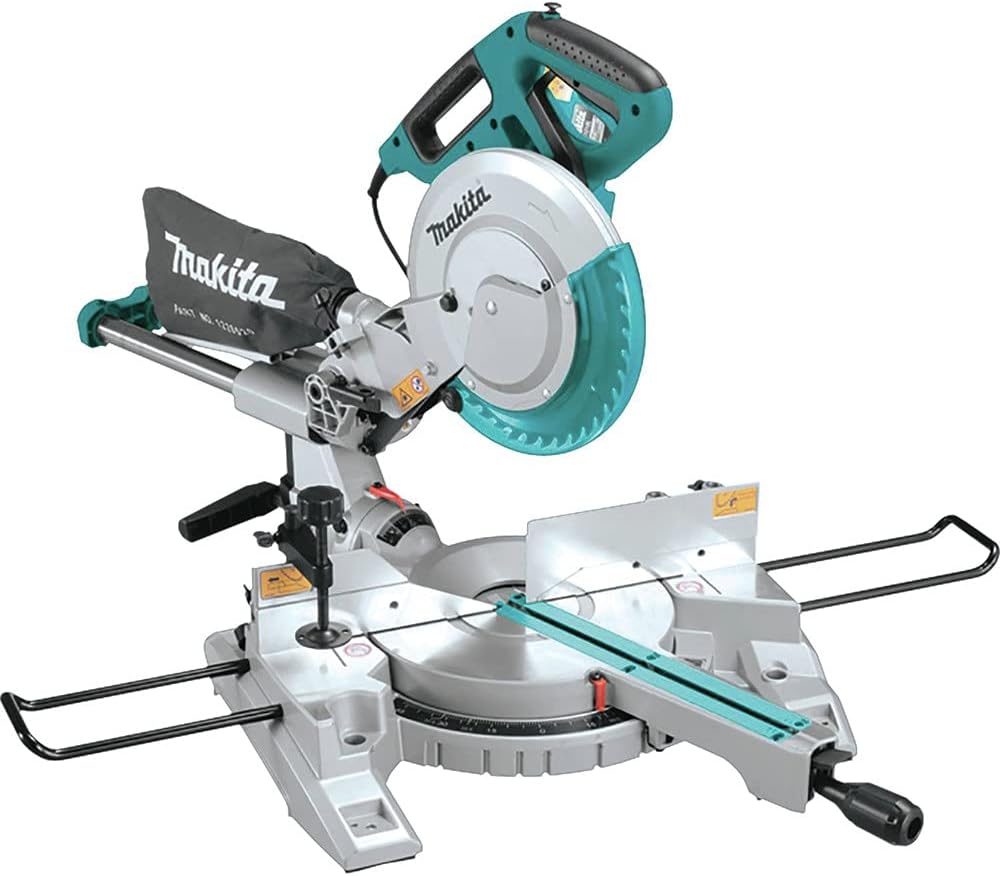
Capacity is the number to check first. A non sliding 10 inch saw handles roughly nominal 2×6 flat at 90 degrees, and a slider extends that considerably, which is why 12 inch sliders suit wide baseboard and stair treads. Cordless sliders exist too: the Makita XSL06PT runs two 18V batteries for 36V performance with automatic speed change under load.
What a table saw does that nothing else does well
Ripping to a precise, repeatable width is the table saw’s core job. A fence set at 2-3/8 inches produces boards at 2-3/8 inches, one after another, with parallel edges. That capability underpins cabinetmaking, face frames, drawer boxes and any project where parts have to match.
Rip capacity, the distance from blade to fence at full extension, decides whether a full sheet can be cut in half safely. The RIDGID R4518 offers 27 inches on a folding stand with a 4 second blade brake, which covers half a sheet plus trimming. A smaller jobsite saw such as the Rockwell RK7323 weighs about 15 pounds with tool free blade changes: portable, but not a panel saw.
A table saw also crosscuts, using a miter gauge or a shop built sled. That is slower to set up than a miter saw, but a sled supports the workpiece on both sides of the kerf and can be more accurate on small parts.
Space, dust and portability
A miter saw needs a narrow footprint but a long one, because stock has to be supported on both sides of the blade. On a bench with no infeed or outfeed support it will not cut accurately, since a drooping board lifts off the fence at the cut.
A table saw needs clear space in all four directions: room to feed, room for the offcut to leave, and room to walk around a sheet. Folding and rolling stands change the storage question but not the working one. Contractor style saws such as the Delta 36-6013 come in under 65 pounds with a retracting blade for storage, which one person can move; heavier cabinet saws stay put.
Safety differences that should influence the order
Both machines cause serious, permanent injuries, but the mechanisms differ and that is worth understanding before buying either.
On a miter saw the hazards are hand placement near the blade path, the blade continuing to spin after the cut, and offcuts trapped between blade and fence. Keep hands well clear, let the blade stop before lifting the head, hold the workpiece against the fence rather than freehand, and never reach across the blade for a cut off piece. An electric brake reduces spin down time but does not remove the need to wait.
On a table saw, kickback is the dominant risk. It happens when the offcut binds between blade and fence, or when the workpiece lifts onto the rising back teeth, and the piece is thrown back toward the operator at speed. The riving knife is the main defense and should be fitted whenever the cut allows it. Use the blade guard and anti kickback pawls, use push sticks near the blade, never rip freehand without the fence, never use the fence as a stop for a crosscut, and stand slightly to the side of the blade line.
Blade selection is part of safety on both machines, since a high positive hook rip blade on a sliding miter saw makes the head climb toward the operator; hook angles are covered in the guide to saw blade tooth count. Guard removal, riving knife adjustment and alignment procedures differ between models, so follow the manual for the machine you own rather than a generic sequence.
Options in this catalog
- Makita LS1018 10 inch miter saw. A 13 amp direct drive saw at 4,300 RPM on a linear ball bearing slide, listed at 43.7 pounds with bevel from 0 to 45 degrees. Suits a trim carpenter who moves the saw between jobs.
- Ryobi TSS121 12 inch sliding compound miter saw. A 15 amp saw with a laser guide, two table extensions and an electric brake. Suits a home user cutting wide baseboard or deck boards who wants capacity over refinement.
- RIDGID R4518 table saw. 27 inch rip capacity, folding stand, 4 second blade brake and onboard storage. Suits someone whose main need is ripping and who has room to work around it.
- Rockwell RK7323 portable table saw. About 15 pounds, tool free blade changes, steel rip fence and miter gauge. Suits small parts and light stock in a tight space rather than sheet work.
The full ranges sit in miter saws and table saws. If floor space is the real constraint, the comparison of a circular saw and a track saw covers the third route, and the guide to reciprocating saw uses explains which jobs neither bench machine should be doing.
Frequently asked questions
Can a miter saw rip a board?
No. There is no safe way to feed a board lengthwise past a miter saw blade, and attempts to do it are a common cause of injury. Use a table saw, a track saw or a circular saw with a straightedge.
Is a sliding miter saw worth the extra over a fixed one?
It is if you regularly cut stock wider than a 2×6 laid flat. If most of your cuts are studs and narrow trim, a non sliding saw is lighter, cheaper to blade and takes less bench depth.
Which should a beginner learn on?
The miter saw has a shorter learning curve and fewer ways to go wrong. A table saw rewards study of kickback, riving knives and feed technique before the first cut.